
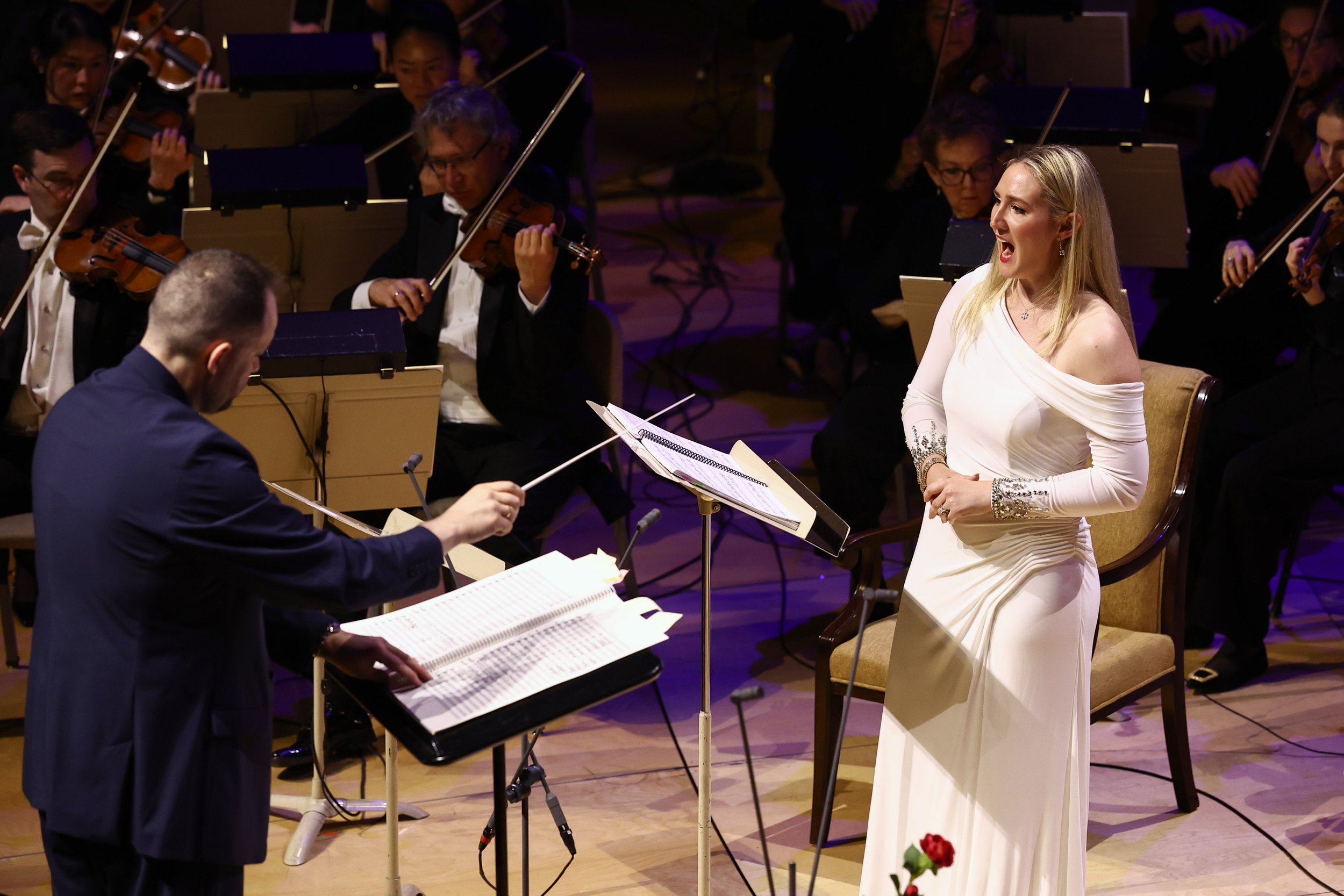
Soprano Samantha Hankey makes a formidable debut with the Boston Symphony Orchestra, singing Erika in Samuel Barber’s Vanessa, Jan. 8. Andris Nelsons conducts. Winslow Townson photograph
From Classical Voice North America, which collects reviews and features from across the continent. Kindly visit CVNA, a robust source of music journalism. Reading here is a small piracy.
Samuel Barber’s Vanessa, semi-staged by the Boston Symphony Orchestra, Andris Nelsons conducting, in collaboration with the Boston Lyric Opera, Jan. 8 and 10 in Symphony Hall.
Semi-staging opera invites challenges.
The main reward seems self-evident: to illuminate the great opera scores—like Samuel Barber’s Vanessa, which the Boston Symphony Orchestra semi-staged Jan. 8 in Symphony Hall. Limited staging brings musical issues directly into focus.
But when soloists arrange themselves onstage with a sizable orchestra, another chamber ensemble, and with two choruses stuffed into the lobby, semi-staging leaves too many sonic obstacles to overcome. Barber’s luxuriant score provides enjoyment right from the overture, and music director Andris Nelsons excelled with its many details. But the difficulties that some of soloists had projecting, let much of the steam out of its enjoyment.
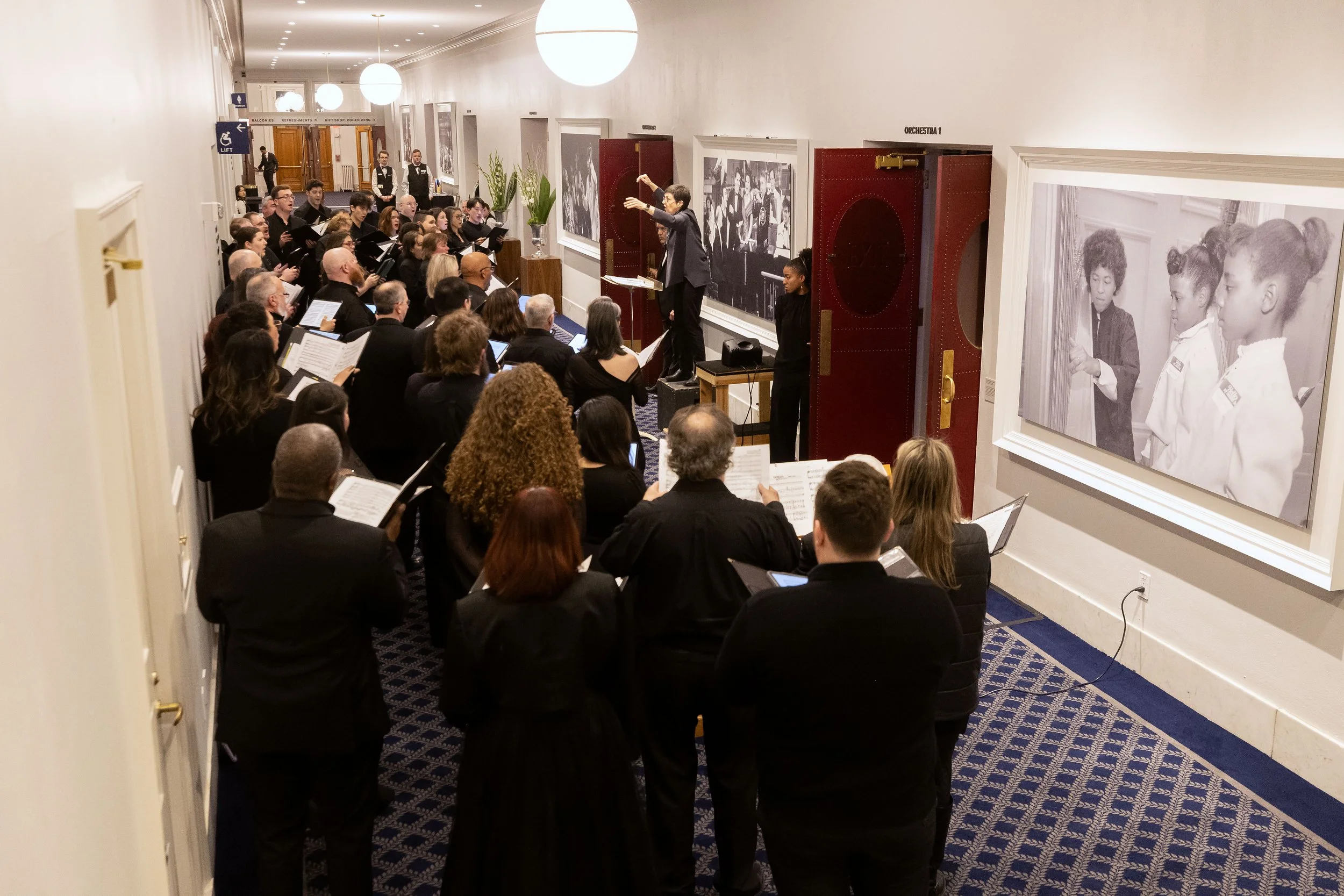
Two choruses, one hallway: The Tanglewood Festival Chorus and the Boston Lyric Opera Chorus, under the direction of Betsy Burleigh, in Barber’s Vanessa, Jan. 8 in Symphony Hall. Or nearly in Symphony Hall. Winslow Townson photograph
Barber’s Vanessa, with libretto from his longtime partner Gian Carlo Menotti, stormed onto the scene in its much anticipated 1958 premiere at the Metropolitan Opera. Anticipation? It was the first full-length American opera at the Met in two decades. Two years before the premiere, before Barber wrote a single note—after Menotti had merely completed the libretto—the New York Times ran a breathless article about its progress. Imagine. Vanessa won a Pulitzer Prize that year.
The opera’s production history seems spotty compared to the starry debut, but it has found its artistic champions. Barber’s vocal score loves its soloists, especially the two female leads, and multiple one-namers—Kiri, Flicka, Steber—have graced the roles. Soprano Jennifer Holloway sang Vanessa here, with mezzo Samantha Hankey in the more prominent role of her niece Erika. Neither of these two striking singers had any balance issues during the evening.
Menotti creates a stagnant parlor drama: the Baroness Vanessa has waited twenty years for her departed lover Anatol to return. Time stands still in the barony: Vanessa has covered the mirrors and hidden herself away, avoiding any sight of change. Her niece Erika (about 20 years old herself, hmmm), lives with her. Might Vanessa be her mother?—Menotti drops no hints. The ambiguities enhance the narrative.
Anatol finally returns—but as Anatol junior, son of the long-gone (now-dead) lover. The parlor reawakens. Anatol proves a rake by inheritance, bedding Erika the very night of his arrival, then immediately turning to Vanessa and confoundingly winning her over.
Quite soon Erika is pregnant, Vanessa feels delusional love for the father/son, some part of this must be incest, and everyone should be booking time on a couch. Erika’s life unravels, as Vanessa and Anatol marry and leave her behind. The opera closes with Erika re-covering the mirrors, and resuming Vanessa’s place in waiting.
Were it powerfully executed, this story could be tense as Ibsen or Chekhov. This libretto is not. In fact, Barber’s music shows far more empathy and suggestiveness than the libretto achieves. In Barber’s infectious voice the music traipses easily through angular segues and chocolate-smooth arias. An elegant baritone himself, Barber gifts his singers with lines that sit lovingly in their instruments.
Holloway and Hankey, the blended star-crossed stars, both sang elegantly over the dim, with distinction and power. Hankey articulated Erika’s complexities with energy, and her fans should hope that “Must the Winter Come So Soon” never leaves her repertory. As an actor—even with the recital-type limitations of semi-staging—Hankey convincingly portrayed Erika spinning herself into victimhood, all the while marveling at other’s delusions. Even with limited acting, this was an acting tour-de-force. Couple that with her instrument, and Hankey has power-star qualities.
Vanessa maintains an indifferent relationship to reality, and Holloway blithely emboldened her character’s follies. Her long-awaited lover is dead, but she falls for his shady son almost instantly, then thoughtlessly plans to abandon her niece. Holloway made it all believable.
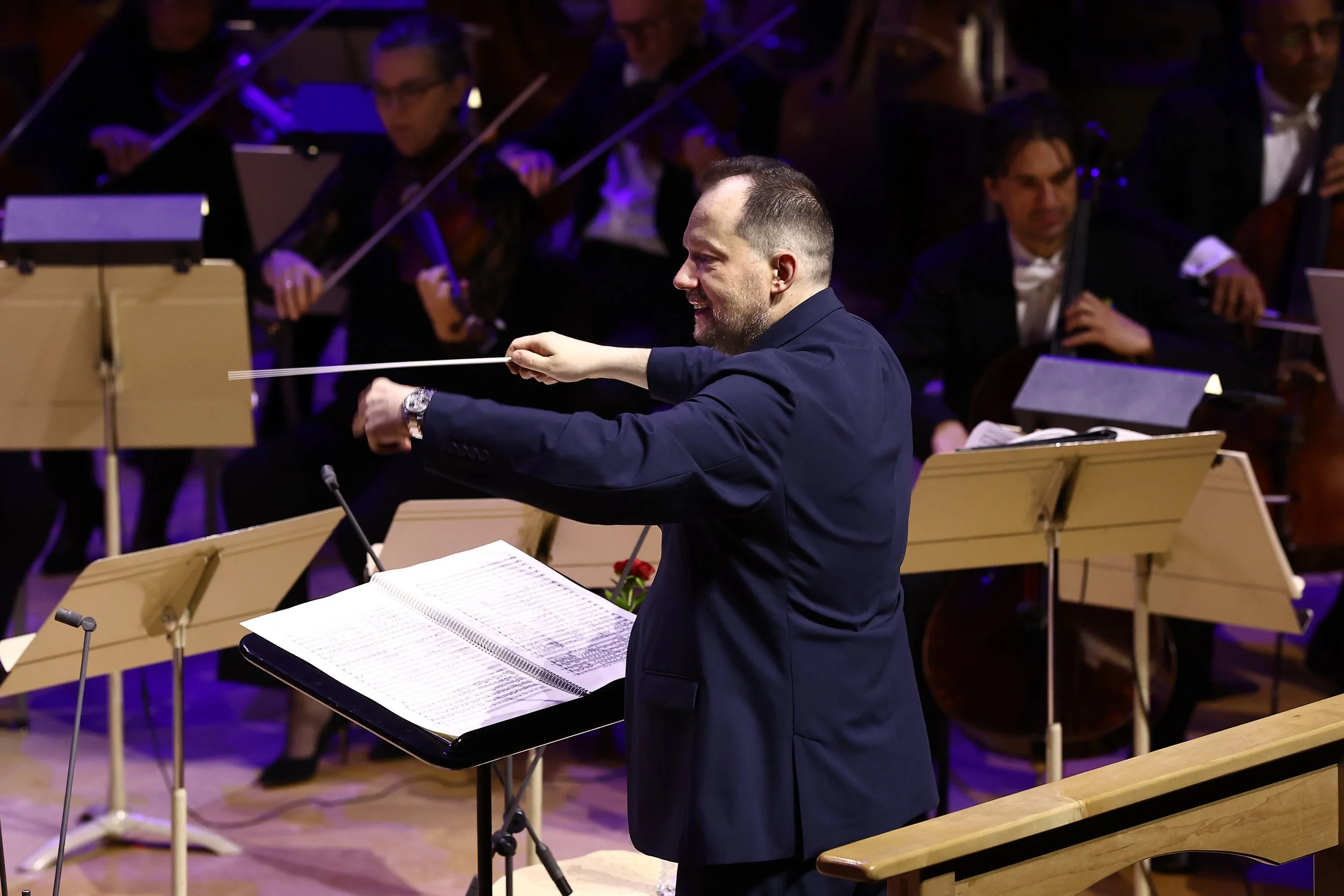
BSO music director Andris Nelsons. Solos and accompaniments drifted through harp, English horn, flute, along with chamber settings and solos among the string principals—densely orchestrated all, executed with intensity. Winslow Townson photograph
Both male leads were substitutes, although not new to the roles. Tenor Ganson Salmon sang a polished Anatol, but well under the mix too often. Noted mezzo Anne Sofie von Otter and bass Wei Wu, in supporting roles, met their fate as well in the sonic barrage. Too often the supertitles alone provided narrative. But Patrick Carfizzi stepped in successfully as the nostalgic and comic Old Doctor, singing with robust flair.
The production was a collaboration with the Boston Lyric Opera, whose chorus was joined by the Tanglewood Festival Chorus in the intimately sized entryway.
Music director Andris Nelsons relentlessly pursued the details in Barber’s delicious score. Solos and accompaniments drifted through harp, English horn, flute, along with chamber settings and solos among the string principals—densely orchestrated all, executed with intensity.