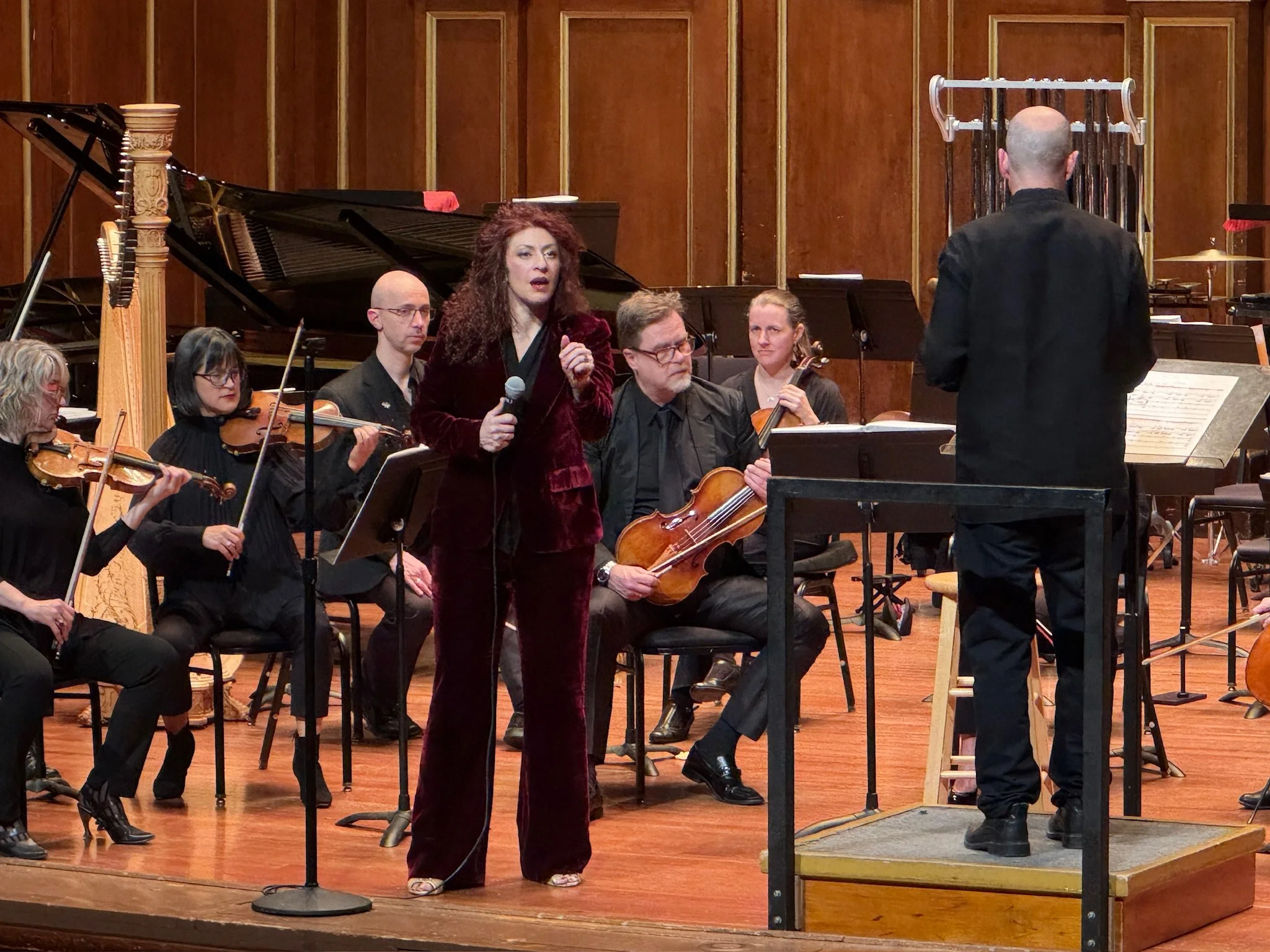
Don’t look: Soprano and actor Julia Mintzer sings William Bolcom’s Medusa, with Gil Rose conducting the Boston Modern Orchestra Project.
Solo voice and orchestra, usually with dramatic text: the challenging genre called Monodrama. The setting feels under-explored, after an intense evening of three contemporary American works with the Boston Modern Orchestra Project, its leader Gil Rose, and a trio of compelling vocalists, Feb. 21 in Boston’s Jordan Hall.
Soprano Julia Mintzer sang William Bolcom’s Medusa; baritone Michael Chioldi realized Ahab, from Ronald Perera’s The White Whale; and soprano Sarah Coburn sang Carlisle Floyd’s spiraling portrayal of Eleanor of Aquitaine, Flower and Hawk.
BMOP has been the firm champion of contemporary American music—with Grammys and more than 100 recordings to prove it—for decades. Three works like these, exploring the American idiom in the small ways that filter into its depth, will likely get included in that recorded catalog.
Each of the soloists was singer, actor, performance artist—in equal measure. To believably conjure a character, develop gestures and maintain tension in the spare front of stage, with no props—the result is a tour-de-force of memory and execution. Three artists, and three different imaginings of three unhinged stories.
It took only a few scenes to be reminded that William Bolcom is a magical musical chameleon. His Medusa (2003, libretto by frequent collaborator Arnold Weinstein) offers twelve such scenes as elusive musical snapshots, set for soprano and string orchestra.
Julia Mintzer, singer and actor and excelling at both, envisioned the snaky Gorgon. The text tells Medusa’s story: youthful beauty, rape by Neptune. Punishment (for being raped, she gets disfigured) by Athena. When Medusa’s gaze kills, her isolation drives her to revel in it. The mood veers, with lots of ugliness. Perseus comes, beheads the Gorgon. Medusa narrates it all, mostly in a spiteful third person (“The Medusa”).
Mintzer examined every shade of bitterness. She played the artful chameleon herself, sounded at times like Carla Bley, at others like Piaf, or Lotte Lenya; intimating a pompous Callas, and sounding like an imposing Callas.
Mintzer used a mike, but not for balance—it was an instrument as well, when the terror of her story dictated. A dark strain in her instrument suited the character. The endlessly intriguing score drifted into and out of ideas, maintaining support but still sounding idiosyncratic. Of the dozen challenging scenes, a Trio, with the first-desk violinists and the soloist, rang out in its simplicity.

Baritone Michael Chioldi sang Ahab from Ronald Perera’s The White Whale. Randall Scott photograph
Ronald Perera’s The White Whale (1981) follows no narration, except for its backstory. Michael Chioldi, lyric baritone, sang out Ahab’s fulminations in sporadic patterns, befitting the madness of the Captain.
Perera’s orchestra added piano/celeste, harp, horns and percussion, and Chioldi unflinchingly strove with the larger ensemble, never relinquishing Ahab’s obsessions. It wasn’t a histrionic telling, but an exact one, with a chilling tinge in its offhandedness. Chioldi sang with single-mindedness, following the straightforward reasoning of the obsessed.
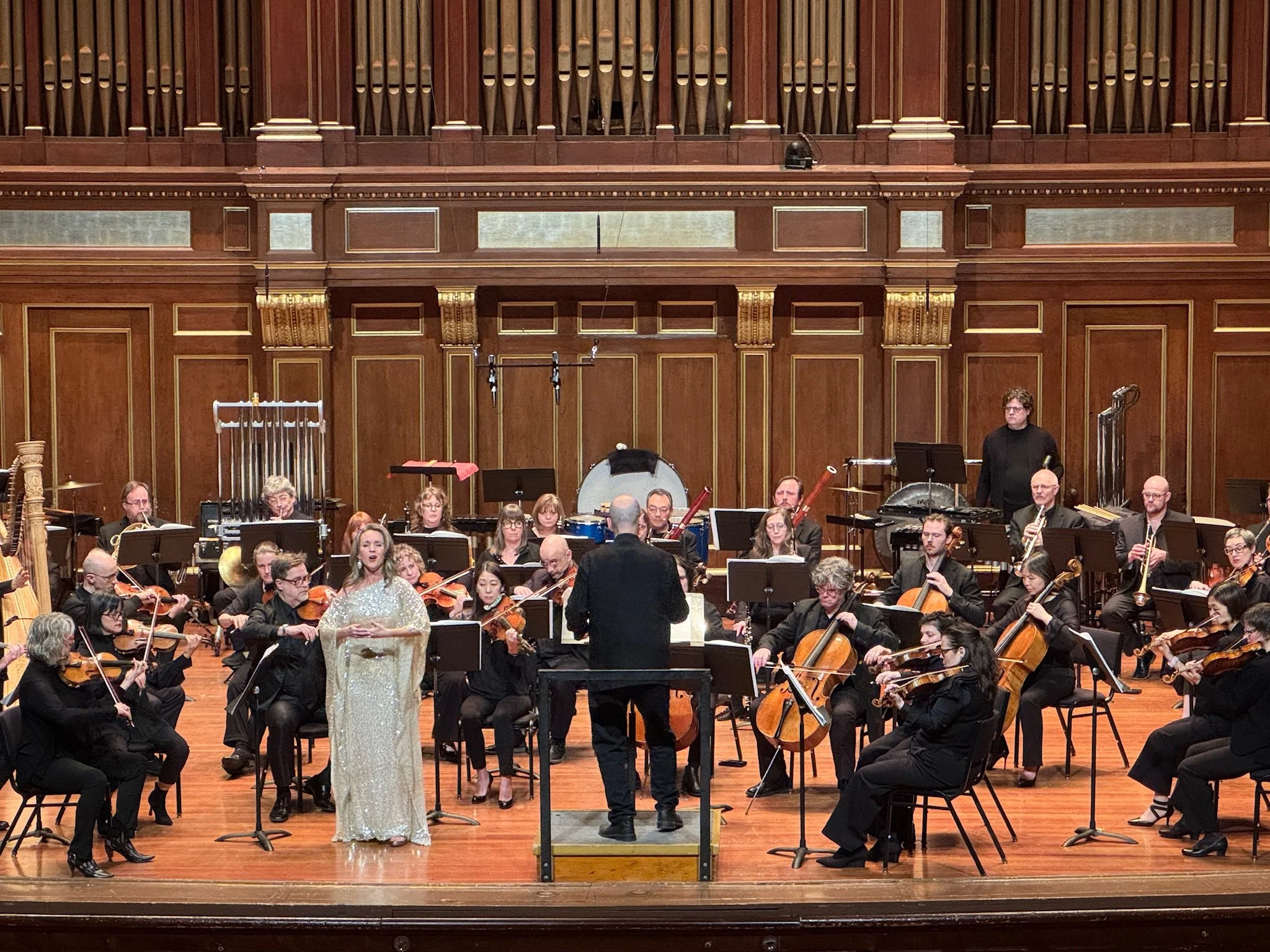
Soprano Sarah Coburn realizes Eleanor of Aquitaine from Carlisle Floyd’s 1972 monodrama Flower and Hawk, Feb. 21 in Jordan Hall.
Soprano Sarah Coburn found another way to bring presence to history, at first standing tall and singing queenly in Carlisle Floyd’s 1972 monodrama Flower and Hawk, but gradually, in one continuous, formidable movement, dissolving from her own memories.
Coburn sang to life the story of Eleanor of Aquitaine, Queen both of France and then of England.
The narration begins in Salisbury Tower, where Eleanor languishes, long imprisoned and ignored. She narrates the details of her husband’s betrayal, her son’s death, her own fall. The story unfolds gracefully at first, then collapses gradually, Eleanor revising her own life as a kind of monotonous fantasy.
Coburn lived the part. She sang effortlessly in varying styles, maintaining impressive tension as her story gathers downward momentum—first standing tall, she ends up collapsing onstage. Equally impressive was the collaboration: singer, conductor, orchestra, all focused on the plunging narrative.