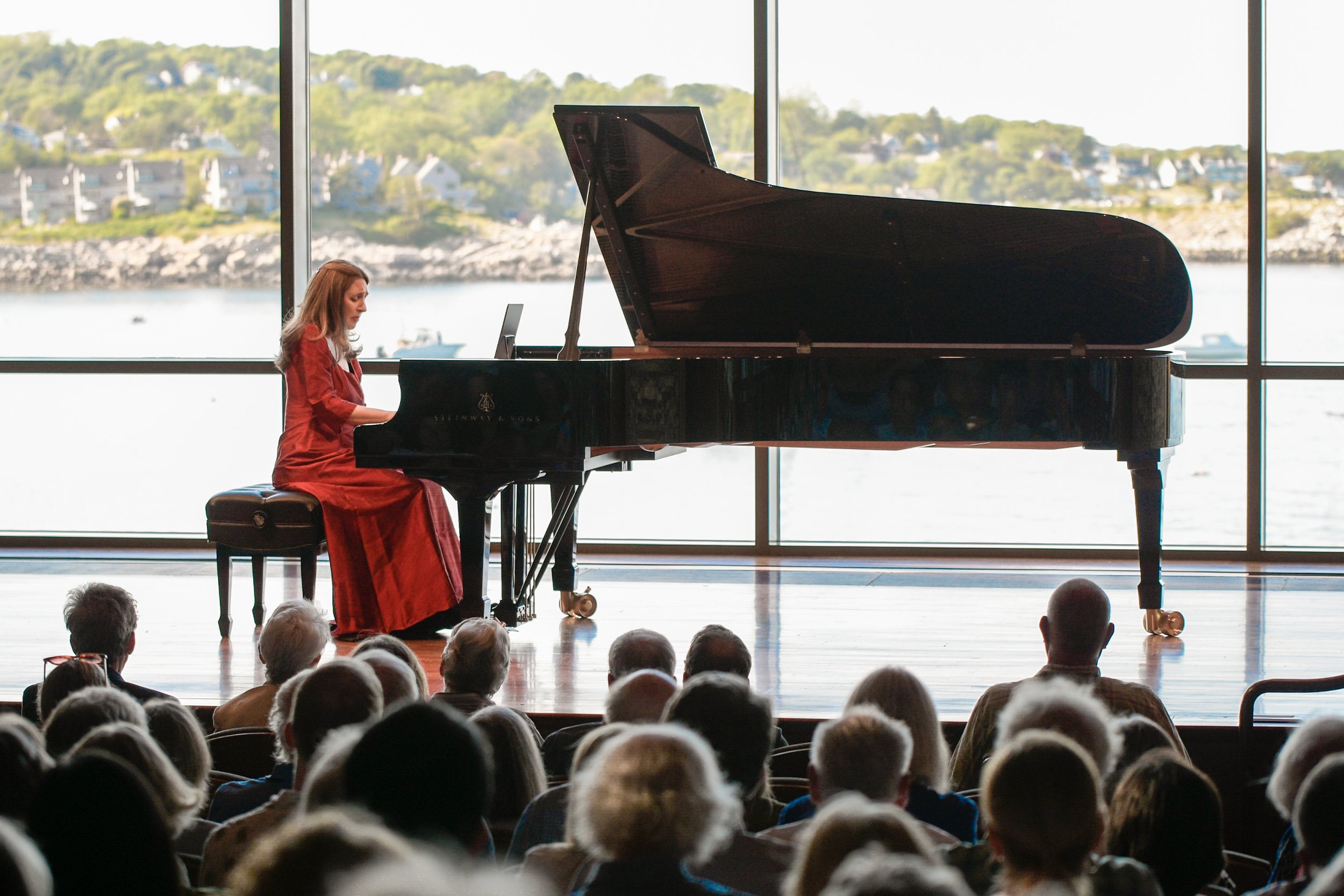
Simone Dinnerstein at the Rockport Chamber Music Festival, June 13. Before she played Bach’s three-part inventions (BMV 787–801) she said, “Theme and variations seem like a family to me, sharing the same DNA.” Julian Mendoza photograph
Shall we start a rousing summer festival with some Brahms lullabies? Why not—there’s a brand-new Steinway concert grand that needs a test-drive.
The Rockport Chamber Music Festival does have a new Hamburg Steinway, with a concert endowment for future artists to give it their own test-drive. And this summer’s festival did start with Jon Kimura Parker playing three gentle Brahms Op. 117 piano pieces. But there is nothing sleepy about the 2026 RCMF, the 45th annual festival along the North Shore of Boston’s coast, and Barry Shiffman’s ninth as artistic director.
After Parker performed the Brahms intermezzi, Shiffman (viola), cellists Mira Kardan and Colin Carr, and violinist Chee-Yun Kim offered Arensky’s A minor string quartet, composed either for two violins or two cellos, here in the double cello version. The dominance of the lower voices in this remarkable setting—two cellos, viola and violin—made this densely orchestrated work sound both recognizable as, but slightly adjacent to, the typical string quartet sound-world.
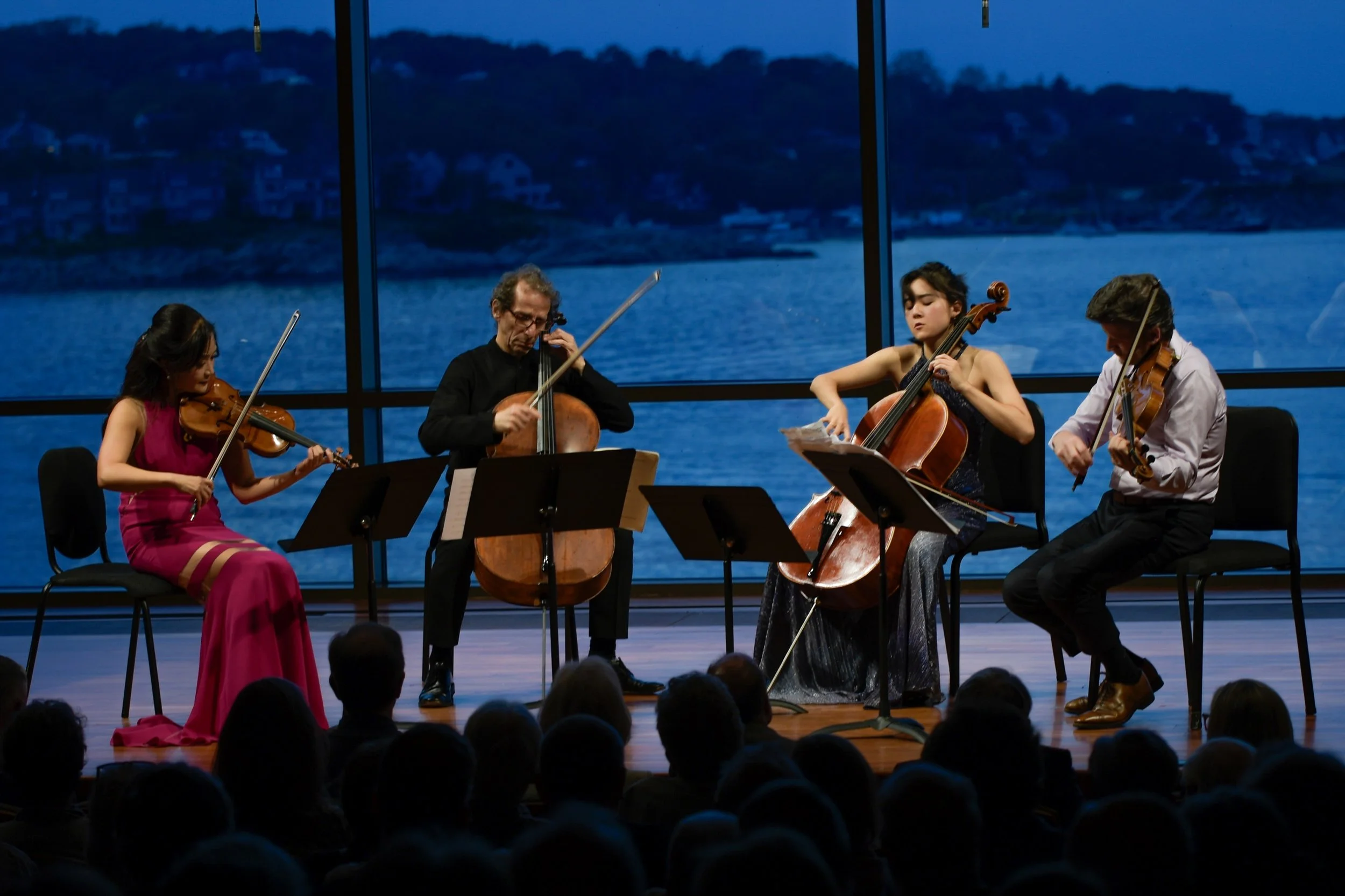
Opening night at RCMF, June 12, included Arensky’s A minor quartet, here in its two cello version. From left: Chee-Yun Kim, Colin Carr, Mira Kardan, Barry Shiffman. Sara Levenson photograph
Parker then returned with Carr, Shiffman and Kim for Brahms’s Op. 60 C minor quartet, traditional instrumentation for a piano quartet, but inventive in its own ways, performed with “let’s get this festival started” energy. The June 12 concert presented a snapshot of RMCF's strengths: younger musicians mixing with established performers, programming both the standard chamber repertory, but actively exploring its unusual corners. Plus we got to hear the new Steinway.
The opening weekend also included a glowing performance by pianist Simone Dinnerstein; a major, non-lullaby program of Schubert trios with David Finckel, Wu Han and Benjamin Beilman; and a host of other presentations, kicking off five weeks of music.
RCMF nestles itself seasonally into Rockport Music’s eclectic year-round programming. But it’s chamber music that created it all, which still serves as a linchpin for fund-raising, and brings sure-fire sell-outs to the Shalin Liu Performance Center.
Shiffman doesn’t have to work too hard to convince anyone to come. Decades of music-making have built an enviable audience, which fills the hall for morning programs, afternoon masterclasses and evening concerts alike. The Shalin Liu Performance Center, built for chamber music, draws praise from performers of all instruments. A tradition of marquee artists—Yo-Yo Ma, Bell, Denk, Ohlsson, and for this year’s summer gala, Yuja Wang—has graced the stage. And there is the new Steinway, which moves the American Steinway upstairs into the casual SLPC performance space. It can seem an embarrassment of chamber music riches.
The festival began in the early ’80s, conceived by soprano Lila Deis and pianist David Alpher. First performances were in an art association’s converted barn, with the lack of comfort that implies. After a few decades of great music and perspiring audiences, RMCF built its own home in 2010, the 330-seat Shalin Liu Performance Center, fashioned not only with air conditioning but with outstanding acoustics, and a backstage window looking over the harbor. Pianist David Deveau spearheaded that initiative as artistic director, and Shiffman replaced the retiring Deveau in 2018.
With the new hall came year-round programming, and a jolt of new genres—not an easy transition. Rockport Music survived that, and the pandemic, and now offers more than 150 programs annually. Maintaining RCMF as the centerpiece, but also bringing new audiences and alternating genres, becomes the primary focus for president and CEO Suzanne Wilson.
“The foundation of the entire organization is the festival,” she says emphatically, “and we’re cultivating from that what Barry has built up. Right now our programs are about 30 percent classical, with some fifteen other genres.
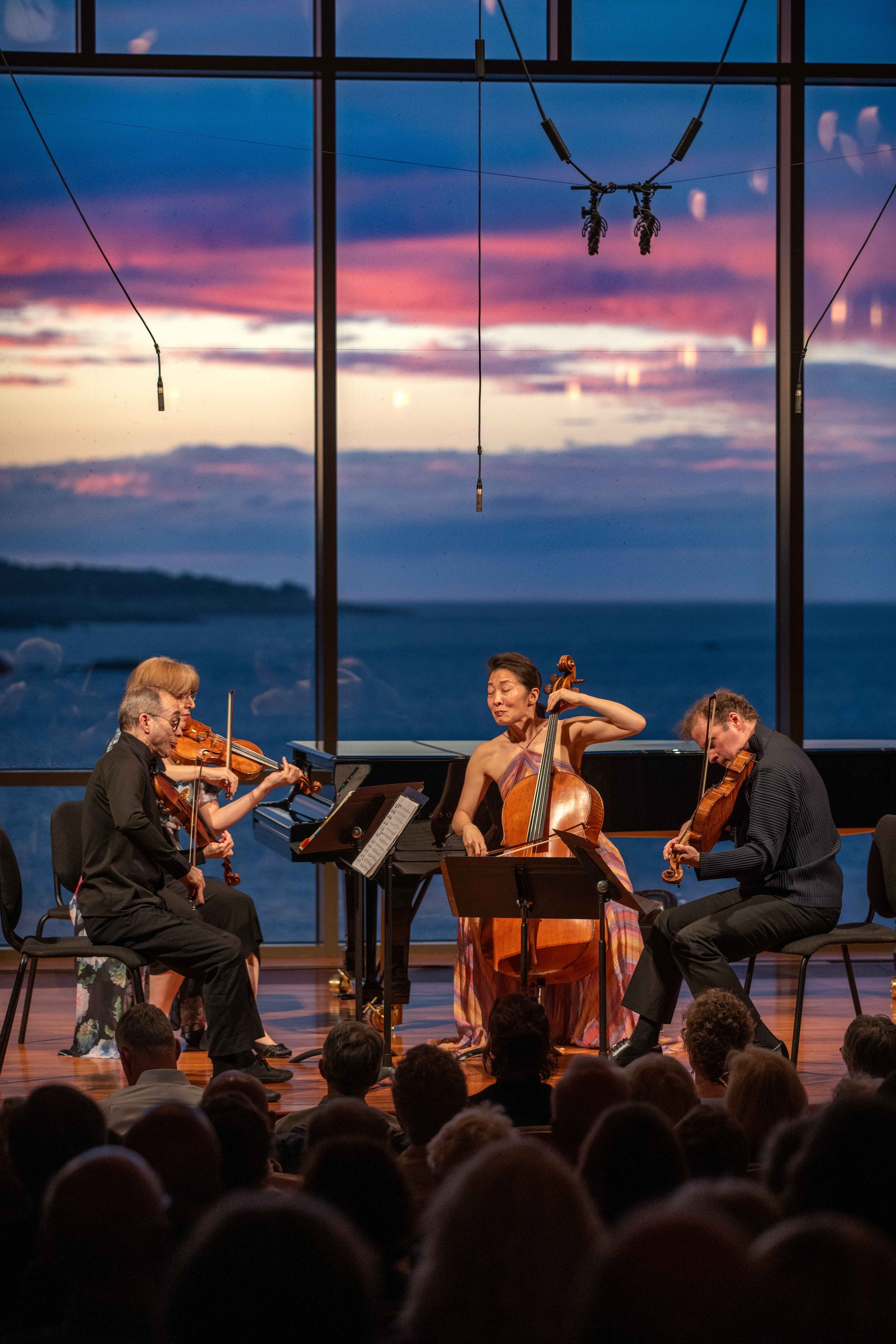
Brentano Quartet, frequent RCMF guests, perform June 18, playing early Hadyn and early Beethoven quartets. From l: Mark Steinberg, Serena Canin, violins; Nina Lee, cello; Misha Amory, viola. Julian Mendoza photograph
“Every performance has overarching quality,” Wilson says. “Our iconic hall. A personal experience that resonates with everyone. Artists in different stages of their careers. We have the reputation, and we’re building an infrastructure to mirror everything—jazz, pop, blues, films, everything—with the chamber music.”
Simone Dinnerstein’s June 13 program was a calling card of the pianist’s own interests, including Bach, Philip Lasser, and, for a stunningly long encore, Philip Glass. She played sequences: Lasser’s variations on a Bach chorale; Bach’s three-voice Sinfonias; Rameau’s Gavotte with six doubles. “Theme and variations seem like a family to me,” she said from the stage, “sharing the same DNA.” It was family with variety: Lasser’s angular extrapolations on “Nimm von uns, Herr, du treuer Gott”; Bach’s intertwined figures; Glass’s gradually developing revelations.
David Finckel and Wu Han returned to Rockport with violinist Benjamin Beilman, programming the two late Schubert trios, D. 898 and D. 929. The music was enriched by experienced collaboration, reflecting equally Wu Han’s Romantic flair, Finckel’s almost stately energy, and Beilman’s facile virtuosity.
A pair of Saturday morning sonata recitals began with survey of cello duos, Mira Kardan and pianist Micah Yu shifting from introspective (Beethoven No. 3) to lyrical (Dvorak’s shadowy Silent Woods), and then switching to comically virtuosic (Castelnuovo-Tedesco’s “Figaro” arrangement).
Democracy thrives with the conductor-free string ensemble A Far Cry, frequent festival guests who performed June 19. The Criers’s concert repertory gets curated and then led by rotating members; violinist Jesse Irons anchored this lean version of Mozart’s Clarinet Concerto, K. 622. Two dozen Criers surrounded soloist Anthony McGill on the SLPC stage—impressive stage management.
Conductor-less does not mean rudderless. With no baton to follow, McGill’s eyes never left Irons, who stood and lead the ensemble in countless distinct gestures. With the McGill enveloped by his concerto-mates, the typical soloist/ensemble opposition mostly disappeared. Balances went loony, but the idiosyncrasies brought familiar music alive with unexpected sparkle.
Festival musicians commonly explore unusual repertoire. When permanent ensembles come to explore their core repertoire, as the Brentano Quartet did with early Haydn and early Beethoven on June 18, performances seem more sensitively informed and shaped.
Haydn Op. 20, No. 4 and Beethoven Op. 18, No. 1 have similarities that mean little. Both are early quartets for the composer; neither sounds like juvenilia. Both quartets wrap themselves around Affettuoso second movements: in Haydn’s case, equality presides, each voice calmly distinct and each player listening attentively.
But Beethoven’s “affettuoso” is tragically ironic: his second movement strives for symphonic drama, depicting one of the starkest moments in literature or music: the tomb scene, when Juliet finds Romeo’s body. Brentano read the movement with intensity; the shocking beginning of following scherzo sounded like an affront.
Such appreciations only come from expert and confident playing. It was more of the same when pianist Jonathan Biss joined Brentano for Dvorak’s A minor quintet, and when Biss teamed for another engaging sonata recital (all-Mozart) with Brentano violinist Mark Steinberg, June 20.
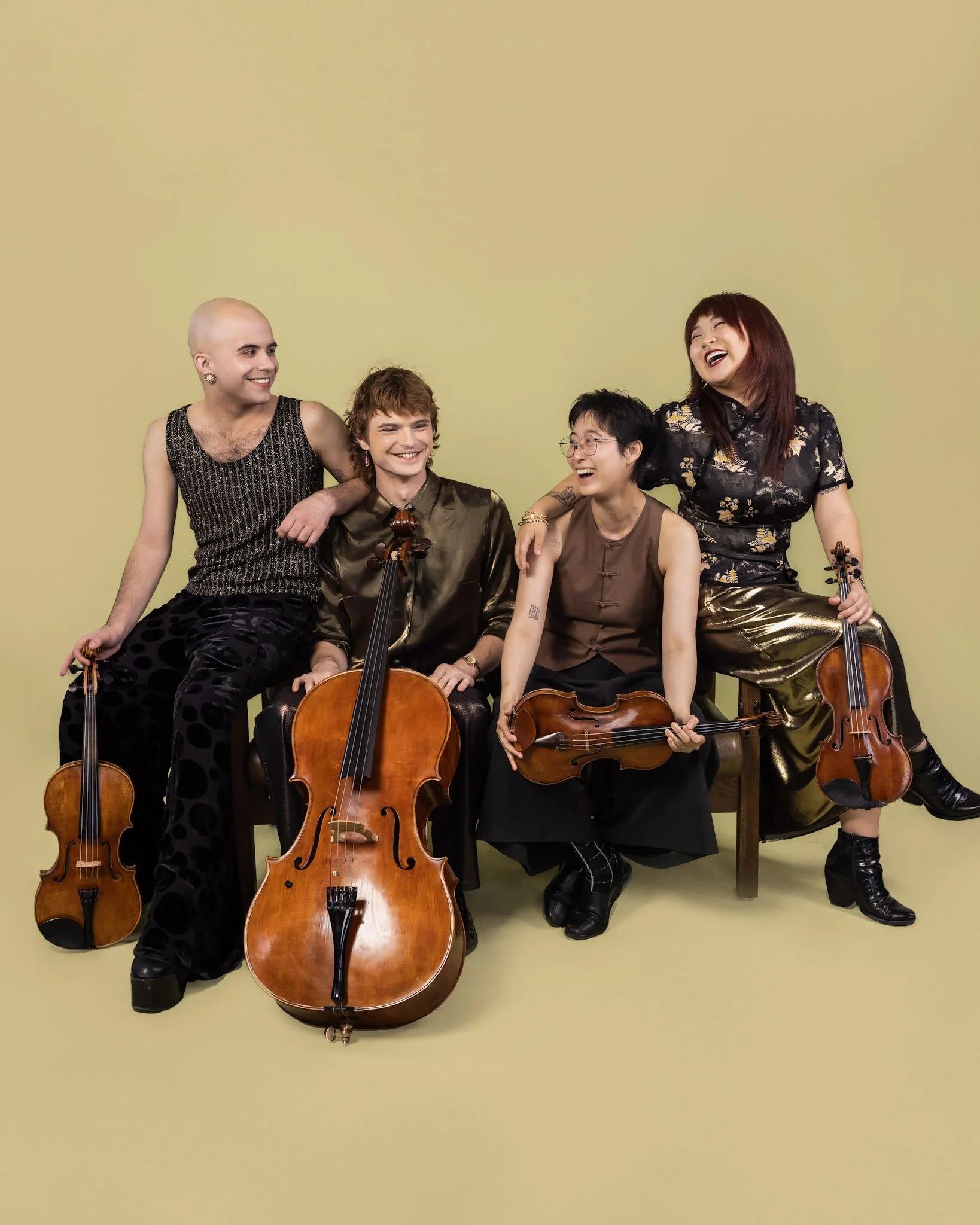
Poiesis Quartet, 2025 Banff International String Quartet Competition winners, perform June 27. From left: Jasper de Boor, viola; Drew Dansby, cello; new member, Sarah Ying Ma (violins).
RCMF runs officially through July 12. Violinist Augustin Hadelich performs June 28. Joshua Bell joins soprano Larisa Martínez July 2, then plays Schumann with cellist Steven Isserlis and pianist Jeremy Denk July 5. Last fall’s Banff competition winner, Poiesis Quartet, performs June 27, and previous competitor quartets Terra and Balourdet return July 9. Four addition programs in August serve as festival encores, including recitals by the Hamelins (four-hands, with Marc-André and Charles Richard-) and Jean-Yves Thibaudet. —Keith Powers