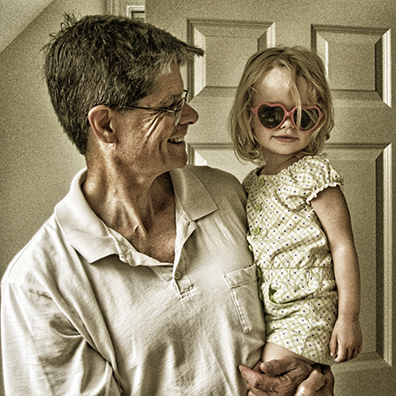
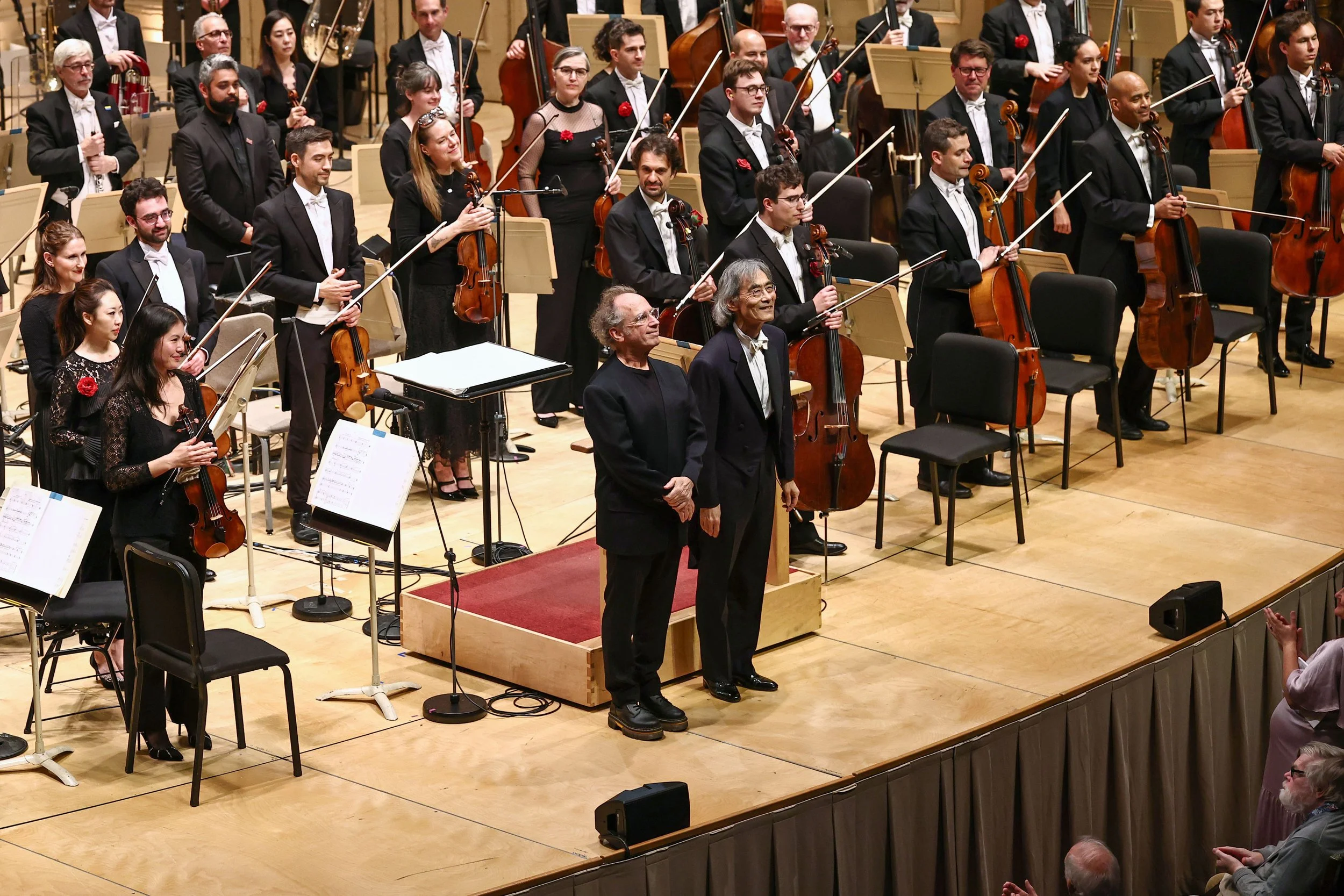
Composer Tod Machover (left) and conductor Kent Nagano after the premiere of Machover’s already and not yet, a concerto for orchestra, AI and electronics, Oct. 22 in Symphony Hall. Winslow Townson photograph
If anyone has experience negotiating the treacherous intersection of AI and classical music, please step forward.
Enter Tod Machover.
Machover, composer and director of Massachusetts Institute of Technology’s Media Lab, has spent a lifetime seeking equilibrium between acoustic and electronic sounds. His latest attempt, already and not yet, concerto for orchestra and electronics, which engages AI as a real-time musical partner, was premiered by the Boston Symphony Orchestra and conductor Kent Nagano in Symphony Hall on October 24.
The work follows a path that Machover began following half a century ago. The concerto engages the orchestra as live performers, and as collaborators with his own artificial intelligence software. Machover placed a computer-managed sound enhancement system amid the orchestra (a system developed and controlled by MIT’s Manaswi Mishra), and populated Symphony Hall with surround-sound speakers as well.
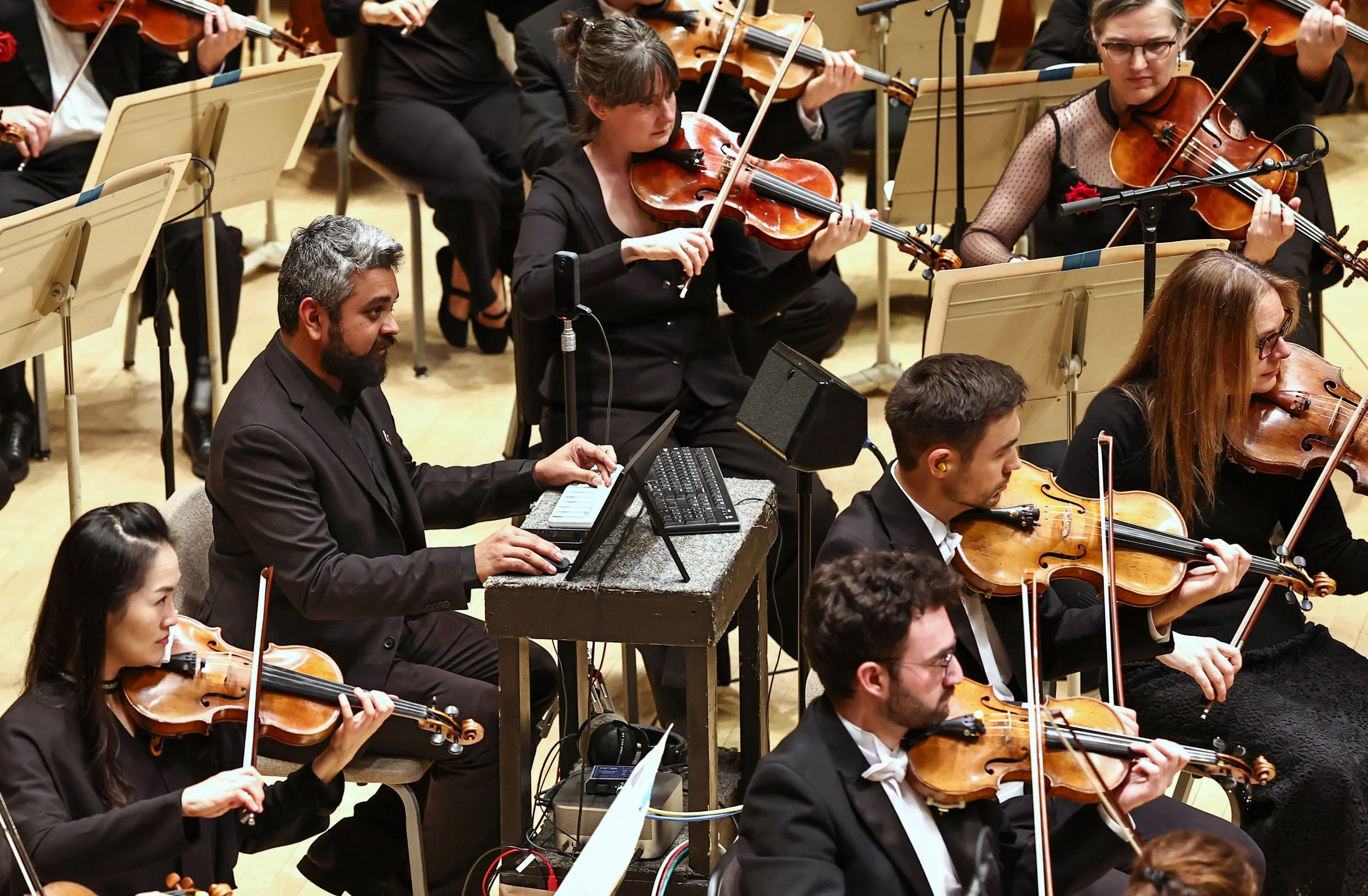
Manaswi Mishra (at computer), who developed the AI program for the premiere, performs with the Boston Symphony Orchestra. Winslow Townson photograph
Machover brings human intelligence, and experience, to these experiments. He spent seven years in the ’80s with Pierre Boulez’s electronic-music ensemble, IRCAM. From there he went to MIT, where he has been director of the artistically adventurous Media Lab for 45 years. His compositional studies include work with Dallapicolla, Carter, Babbitt and Sessions.
Machover’s seven operas have involved taped sounds, invented electronic instruments, and robots (in 2010’s Death and the Powers). Brain Opera (1996) explores the ideas of Marvin Minsky, among the first to posit that “agents” may develop self-sufficient intelligence. VALIS, an even earlier opera based on the science fiction of Philip K. Dick, explores the same ideas.
This concerto blends the orchestra, the AI system and some recordings as well in an unrepeatable live performance. The acoustic instruments play triggers and offer rudimentary improvisations; the AI software absorbs and responds. The improvisations, and the AI responses, will differ in each performance—leading to endless premieres.
Three movements are played without pause. The first foregrounds the busy and large acoustic ensemble, pitting brass and winds against the strings, with minimal AI involvement. Because of its brassy, heavily punctuated phrases, and accessible energy, it invokes (without the AI) the most well-known Concerto for Orchestra, Bartok’s, which premiered in this same room in 1944.
As the back-of-stage instruments are gradually overwhelming the strings in the first movement, the score warns “Get Ready for AI Solo!” (AI gets its own staff). For the first movement at least, the AI impact seemed limited to enhancing the brass.
AI’s presence increases throughout the second movement, where the software reacts to a dozen or so improvisations, which were passed among the BSO principals. It was a play-and-listen exercise, as AI recreated tone colors but also manufactured its own harmonies and counterpoint, after “listening.” At one point a moving chorale emerges, a melismatic swirling effect. Further on a sampled vocal recording gets triggered, using additional electronics that were managed by collaborator Ana Schon at a soundboard.

Collaborator Ana Schon manages the soundboard during the premiere, as Machover follows. Winslow Townson photograph
The sophistication of the concept did not fully translate to complexity in the composition. Instrumental soloists were encouraged to improvise differently from each other. The improvisations were all based on 2-, 3- or 4-note suggested pitches, and did not fruitfully engage the expertise of the acoustic musicians, reducing them to sonic triggers.
As a listening exercise, it could readily be compared to theme-and-variations, or a call-and-response, but the origin of the sounds was impossible to distinguish after a short while.
In the finale, AI involvement increased as the acoustic participation simplified. A brief AI cadenza—more appropriately a compendium of AI’s greatest hits from the previous half-hour—interrupts the chaos of the third movement. That chaos gets visualized as well—each of the first and second violins were playing different improvisations, like a tableau vivant of two dozen musicians disjointedly playing two dozen different works. The orchestra responded with polite professionalism, but just that.
Viewing the concerto as proof or lack of AI’s artistic effectiveness would be mistaken. The work continues experiments that are rooted in early sound enhancement, like the first electric guitarist who plugged in and listened to feedback. Nearly a century of electronic music-making has made significant artistic additions to composed music; Machover and the MIT team feel like advance scouts, evaluating the suitability of more new terrain.
Kent Nagano added personal links to the program, which included Mendelssohn’s Hebrides overture and his Reformation Symphony, along with another new work, Alex Nante’s Ein’ feste Burg.
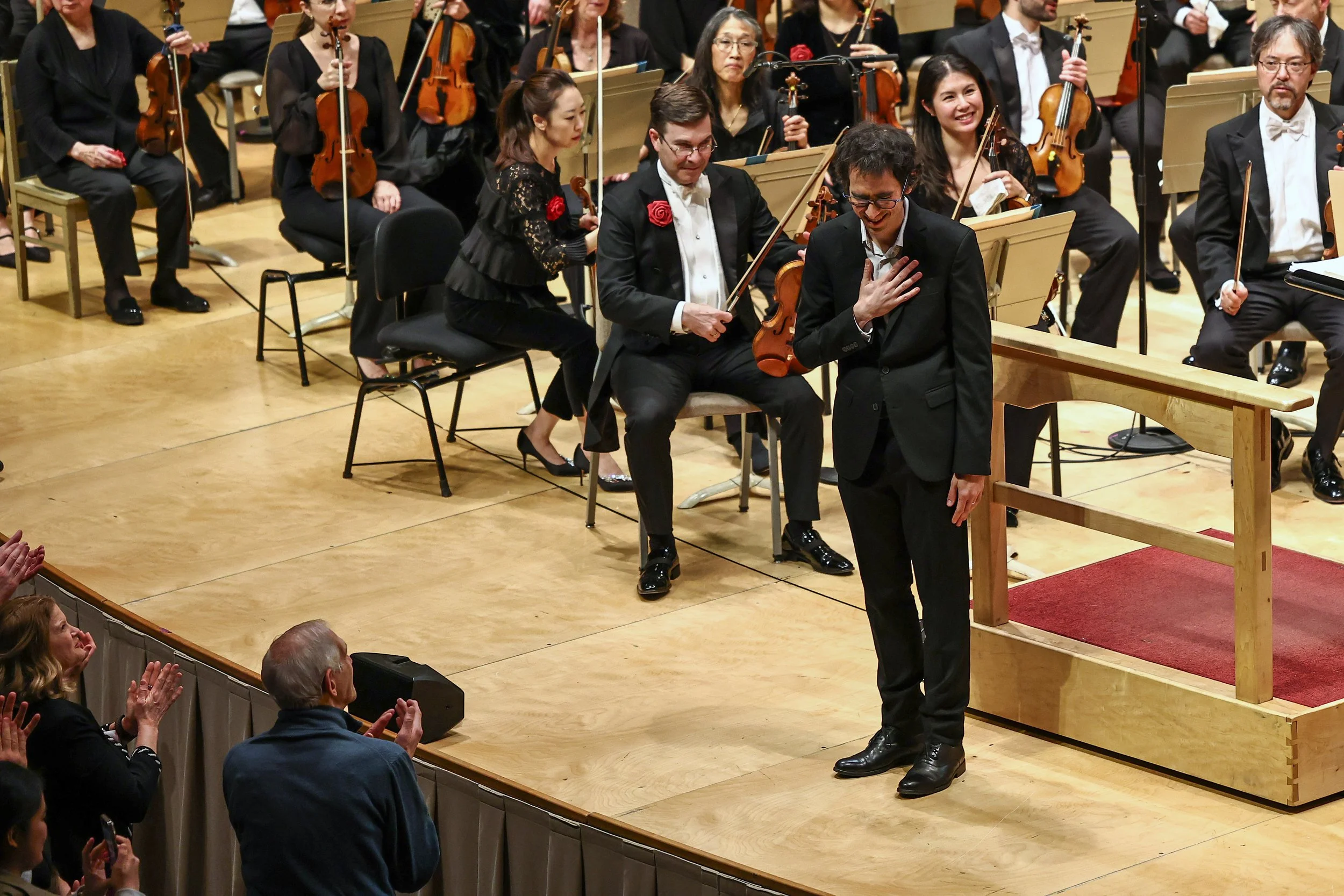
Alex Nante’s Ein’ feste Burg, premiered in 2025, referenced not only Bach but Mendelssohn’s Reformation Symphony as well. Winslow Townson photograph
Nagano began after intermission with Nante’s orchestral imagining of Bach’s famous chorale harmonization. Nante’s commission was premiered last year as part of Nagano’s final program in his longtime artistic home, the Orchestre symphonique de Montréal, and was intended to not only reference its origins in Bach, but its striking inclusion as well in Mendelssohn’s Reformation Symphony, where it sweeps majestically into the final movement. Nante was instructed by Nagano not to alter Bach’s harmonization, but simply to arrange for orchestra.
Nante changed little of Bach, but with greatly original effect: from the high, soft, and slowest possible string texture in the opening, this was its own work. Leaving Bach tonally intact, Berge’s introspective setting deepened the unvoiced text. Bach’s harmonization leveled up the audience through Nante, AI might say, information that might never be lost.
Strikingly, Nagano led without pause from Nante’s one-movement meditation into Mendelssohn’s symphony. It caused some applause confusion, but linked the unmistakable music history in a kind of performance symbolism. The Reformation Symphony hardly makes easy listening, with its stormy tonal centers D and D minor, and its turbulence of ideas and rhythms.
But when principal flute Lorna McGhee articulated the “Ein’ feste Burg” melody in the finale, hearing was made anew, again. Perhaps AI heard it as well.