
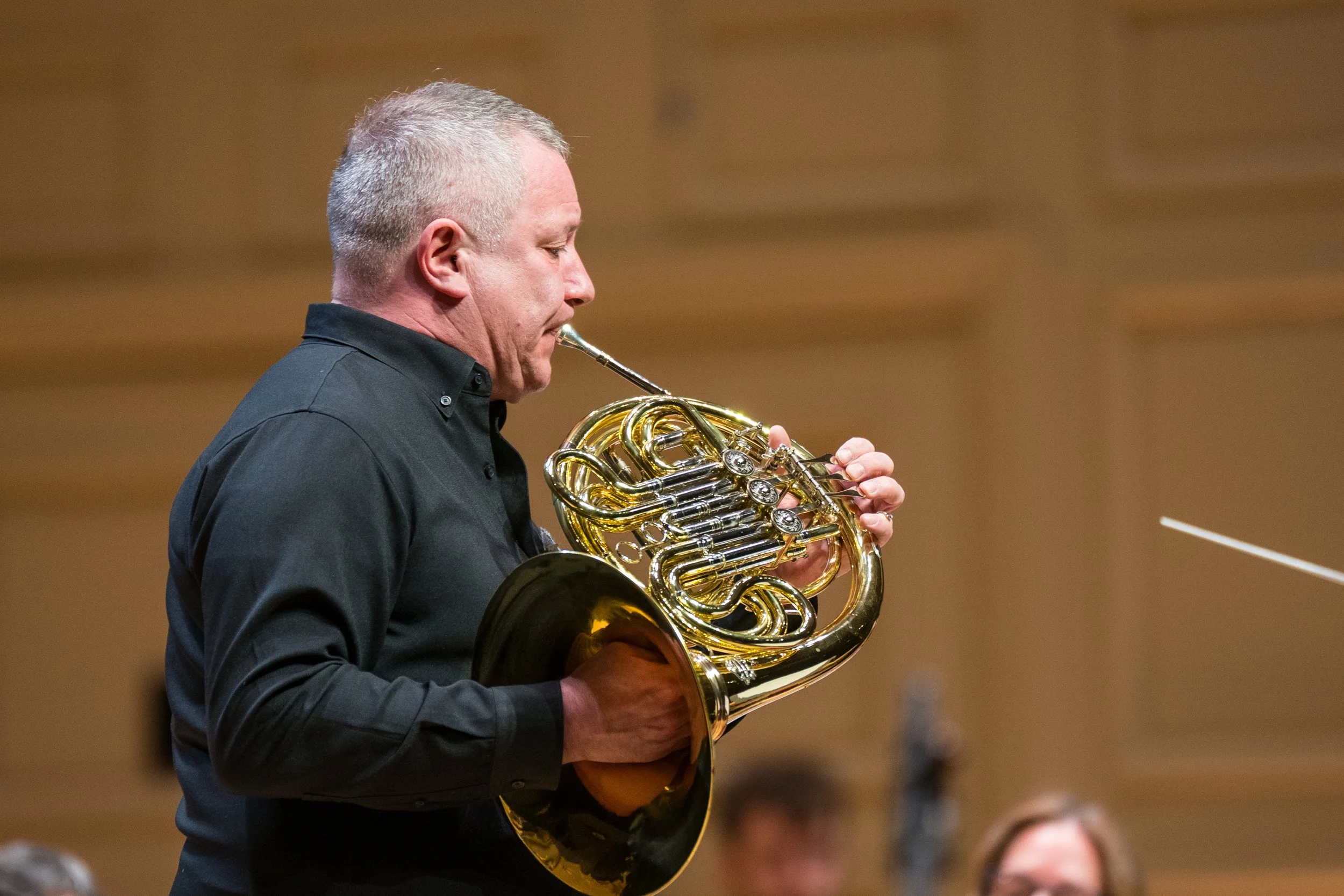
Soloist Stefan Dohr performs Esa-Pekka Salonen’s Horn Concerto with the Boston Symphony Orchestra in its North American premiere, Feb. 12 in Symphony Hall. Robert Torres photograph
Composer and conductor Esa-Pekka Salonen brought his new Horn Concerto to Boston’s Symphony Hall Feb. 12, beginning a busy series of 2026 engagements with the Boston Symphony Orchestra. Hornist Stefan Dohr, long-time principal with the Berlin Philharmonic, was the soloist in a program that included Bruckner’s Fourth Symphony, and a Berio arrangement of Boccherini.
The Horn Concerto was a consortium commission, getting its North American debut here. The world premiere took place in Lucerne this past August, Dohr and Salonen performing with the Orchestre de Paris. All three works on this program featured horns—Salonen’s own first instrument—prominently and referentially.
Salonen’s Horn Concerto serves as a history lesson for the symphonic treatment of the instrument—especially for hornists, who would recognized quotes from diverse works, including multiple references to Bruckner’s Fourth. Salonen’s own note to the piece traces personal links, even quoting Schumann—“the sound of the horn is the soul of the orchestra”—as evidence of his first commitment to the instrument, and to a life in music.
Stefan Dohr’s technique, powerful volume and artistry brought an ease to the challenges Salonen wrote for him. Dohr’s instrument was prodigious as well—appearing about as large as a euphonium, sounding forceful, with a gorgeously smooth, even tone.
The concerto mines shifting textures—episodes that explore a sound-world, then move on. Salonen involved the orchestra in multiple ways: alternating between ensemble and soloist for one, but also writing for divided string sections. To this end the violins sat in a kind of cross-hatch manner, so that both divided ranks and alternate desks could work in tandem.

Dohr and Salonen acknowledge the audience. The concerto mines shifting textures—episodes that explore a sound-world, then move on. Robert Torres photograph
These divisions created subtle differences for each of the three movements. The opening broke the strings into smaller contrasting groups, muting the overall volume. It was chamber music. But in the finale, the same shifting arrangements created a more pervasive mood, ominous and unsettling.
These were gentle innovations. Predominantly, the soloist makes music with his mates in the wind section, with doublings, duets and interplay among French and English horns, piccolo, flute and others. It was a love triangle: conductor, soloist, wind section. Dohr faced constant virtuosic demands: playing as natural horn (without valves) at the remarkable opening, sometimes simultaneously singing gently while playing, or sliding between the open and stopped tones.
It was a history lesson from the composer, and a master class from the soloist. It wasn’t any linear development that drove the listener’s enthusiasm, but the artistic exposition of sonic possibilities. Applause followed each movement; what sounded suspiciously like a wrong-note conclusion dampened the reception only slightly.
Another E-flat call from the winds, emerging at the beginning of Bruckner’s Fourth Symphony, Romantic, instantly recalled Salonen’s own opening. The history lesson continued—Salonen had paired Bruckner’s Fourth for obvious reasons, including the recognizable Scherzo, an obsessive clarion phrase. Salonen noted how he had conducted the Fourth as a 21-year-old in his diploma recital, for one of his mentors, Finnish composer Einojuhani Rautavaara.
“Romantic” was Bruckner’s own descriptor for the Fourth, but it would be better served by Bucolic. Bruckner delivers a country setting, with picnics and hunting scenes, and fulfilled contemplation. But his world is hardly Romantic—there’s no striving against anything, no impetuous urges to greatness or dismay, no inscrutable questions.
Bruckner’s melodies are lovely, his ideas comprehensible. The ideas aren’t grandiose, but they are sacred—simple sacred, like a farmer praising the land, or the stitcher praising the needle and thread, or a family praising the meal.
Musically, Bruckner rarely surprises, intentionally. Melodies get repeated and revised, extending the mood but not dissecting it. The composer lets his sound create a space, and it resides there. The breadth becomes part of the goal. Salonen fostered a sense of relaxed focus on the podium—an admirable approach to a work that originates in a different symphonic era, when audiences expected works to be long.
The evening began with Luciano Berio’s enthusiastic orchestration of a Boccherini excerpt, Ritirata notturna di Madrid, also peppered with wind section highlights. The piece has a fascinating construction: Berio superimposed four of Boccherini’s own transcriptions for different instrument combinations, leaving in the obvious harmonic discrepancies to add comic color. Repeating the same bravura theme (it was a theme with only minimal variations), the antic amalgam gradually dissolved at the edges.