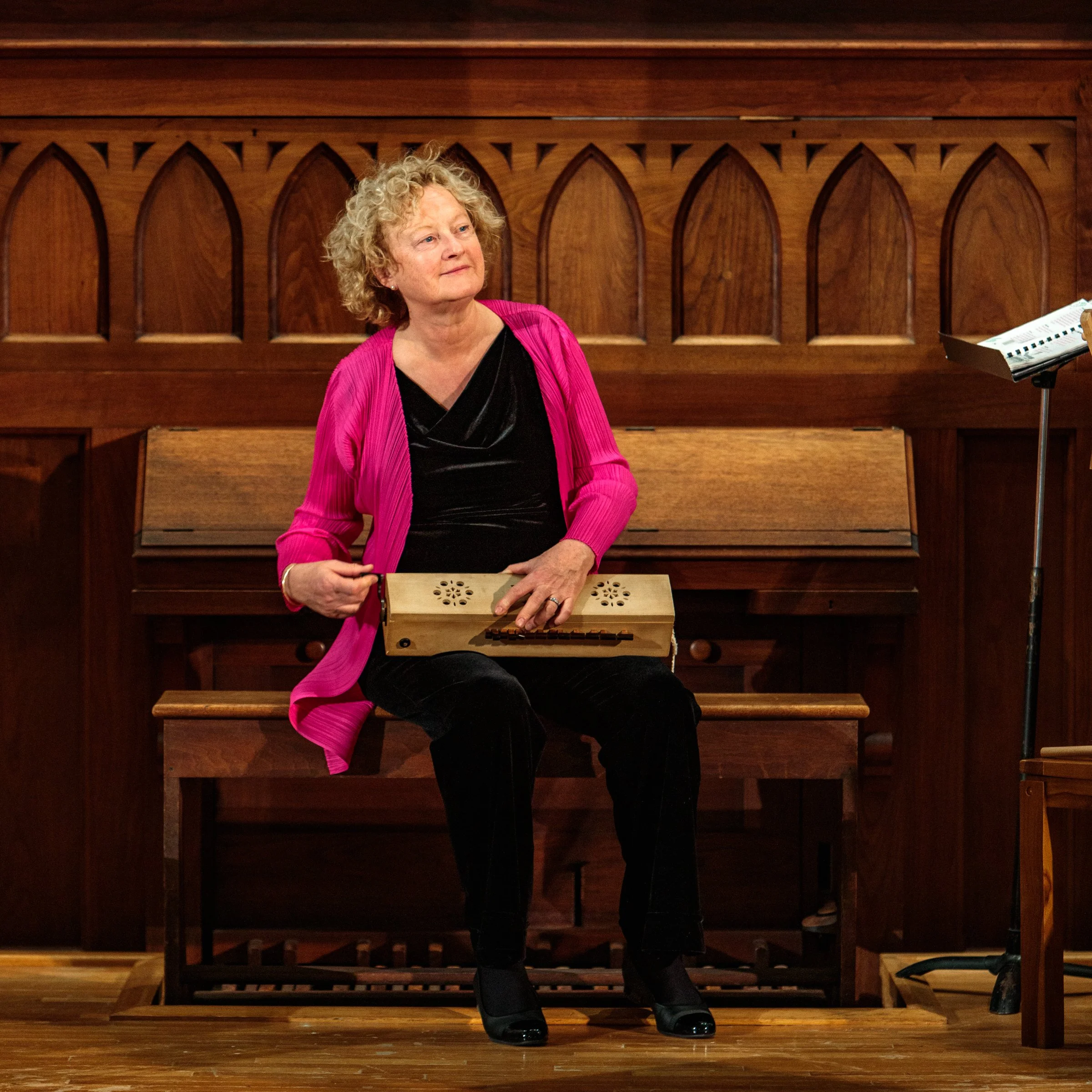
Anne Azéma, with hurdy-gurdy, in one of her solos shows. Azéma narrates and sings the newly released CRPG game Legends of the Round Table, from Québec’s Artifice Studio. Dan Bursler photograph
Picture Anne Azéma, leading her esteemed cohort from the Boston Camerata, performing 13th century music of courtly love and legend.
Now picture Azéma, with the same cohort, performing the same music, but for a strategic, turn-based combat CRPG, recently released on Steam, and already explored avidly by gamers and reviewers on Discord.
One and the same.
The Boston Camerata have been stalwarts of early music since the ensemble was founded in the early 1950s, originally to explore the vast collection of period instruments in Boston’s Museum of Fine Arts. The Camerata has thrived since then, leaders in establishing a foundation for period performance, having compiled an outstanding catalogue of recordings, and performing widely each year, both in America and in Europe. Led by Joel Cohen for decades, the Camerata has been directed by Azéma since 2008.
Azéma also has a one-woman show of her own—“me, myself and I,” she says, and that’s how her experience began with Artifice Studio’s Legends of the Round Table, the computer role-playing game in question.
“In 2018 I sang in a lovely chapel, in Québec,” she says. “A young man came up to me afterward and said, ‘You’re the narrator for my next video game.’ I thought, why not?” The young man was Yan Pepin, founder/director of the Montreal-based studio, an independent game maker.
Pepin is no witless game-boy, nerding out over lasers. A fanatic lover of folklore—“I prefer folklore to fantasy”—Pepin previously created the successful game Sang-Froid, based on legends from his native Québec.
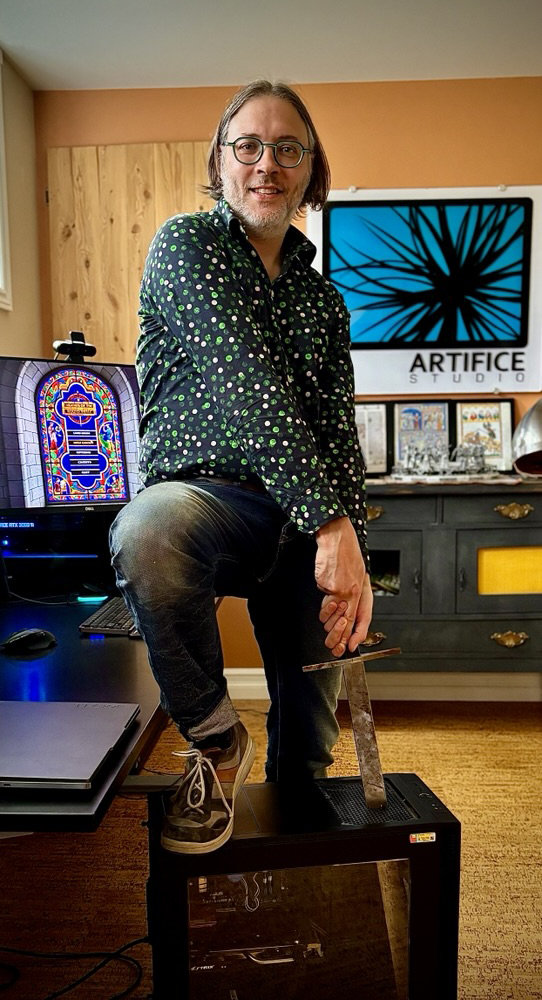
Yan Pepin, founder and director of Artifice Studio. “A game is not only a product, but a work of art.” Florie Pepin photograph
“The idea for me,” he says, “is that a game is not only a product, but a work of art. I create my games inspired by history, but I don’t want to make historical games. I create fictions. Virtual worlds are richer when I start with history. When I create virtual universes, I try to understand the art of the time. The ending is not necessarily historic; I can have flying cities if I want. But I get my foundation in history.
“It was very important to work with people who understood what the music was in the 13th century. I wanted an Eleanor of Aquitaine to narrate the tale and also to sing. That’s why I wanted to work with Anne.
“I always had an interest in everything Middle Ages,” he says, “and I wanted to translate all that fun I had into role-playing legends. I saw there was interest in Arthurian legends, and also that the more they knew, the more people were interested.
“So many people took to the tale of Québec folklore (Sang-Froid) I made. People in Nordic countries had some of the same legends, and it became a success. I even had an orchestra play some of the music. Legends of the Round Table is a continuation of the spirit behind Sang-Froid.”
The process was far more engaging than Azéma expected. “When we met to discuss it, Yan said, ‘I’ve been carrying this project in my imagination, we are finally working on this.’ And I thought he would give me a nice medieval poem and a text, and that would be that.’
“I narrate in all my recitals,” she says, “but then I got the measure of this, the immensity, with all the Round Table legends, what happens if you win, if you lose, every decision you can choose—it’s enormous. I recorded for three years.”
The game takes “30 to 40 hours to play,” Pepin says, and even a brief experience with the trailer shows why. Choices abound for a player’s Knight, each leading to a new pathways. Battles ensue, certainly, but there are negotiations, strategies, fact-gathering, alternate side encounters, and most importantly, a code of honor, all that must be considered.
The music that Pepin wanted for Legends of the Round Table was pure Camerata.
“I wanted the music to blend,” he says. “If the lutenist is accompanying a sad story that turns suddenly comical, I didn’t want it to just fade out and fade in, I wanted something more organic. Something that sounded like a real trouvère or minstrel in the room.”
“When we first discussed music and singing,” Azéma says, “and Yan told me what he wanted, I thought, ‘Some of my pals know all about this.’ That’s how the Camerata became involved.
“The music I contributed are all medieval pieces,” she says. “Yan wanted some, and we contributed some. The songs and instrumental dances are all based on original sources, and the melodies have often been adapted for the needs of the narration. Some, like fanfares, are simple rhetorical contributions.”
It was Azéma’s narration, a blend of singing and speaking, that anchors the game in its historic period. Clélia Pulido-Ferrois of Artifice Studio created the labyrinthine text, first in French and later in English. Those familiar with Camerata performances—often seamless entertainments, driven by a narration packed with authority and allusions to topical events—will feel at home with Azéma’s soft tones and sudden shifts, urging players toward action or toward introspection.
“For me the love of literature from the Middle Ages was the thing,” she says. “It was fascinating to navigate the musical vocabulary, to take the poetry and prose and transfer it to a 2026 game. Slight changes, slight discrepancies make changes in the video.
“I was adamant that I wasn’t going to make the narration sound medieval—‘thee and thou.’ I was always on the border of speaking and singing. Dare I say I’m efficient and quick, but it was a lot of work.
“When you narrate from the 13th century, you narrate in your own head,” she says. “There’s a solitary aspect. You always reflect on the sources, and the manner in which the texts got all the way to us. There is something rewarding in repeating them—you start understanding the weight of the story. I didn’t interject any details—they’re already there.”
Pepin sought the same authenticity in the visual art. Those expecting A.I. combatants should reconsider—the images are hand-painted, and later transferred to digital. Fine-art painter Pierre Arrivé “worked hard for five years,” Pepin says. “His book of illustrations is six inches thick.
“I wanted the techniques of the Middle Ages—if you see gold leaf, it’s real gold leaf. All the graphics are done by hand, inspired by manuscripts. All the colors were available in the Middle Ages. We only bought pigments that were available at the time.
“We have phenomenal visual artists,” Azéma says of the Artifice team. “My contribution seemed small when you have such a creative project.”
“It was Pierre’s first video game illustration,” Pepin says. “He studied as a painter. And we had to adapt to the medium—how do we bring the physical art into the computer. When you paint on parchment there is texture. We had to learn to adapt his art to a video game. Anne and the Camerata had to do as well—it was a leap of faith for her.”
For Pepin, there was no leap of faith from the 13th century to the 21st, when it comes to games and folklore.
“You might not like Call of Duty or Mario Brothers,” he says, “and if you play video games, you won’t become a scholar. But I will ignite a flame, and you will learn about this marvelous universe. This world is infinite.
“You don’t play Legends of the Round Table waiting for a bus. You have to learn the rules. You need to read and get involved. It asks a lot, but it gives back a lot.
“It’s like an artist movie, it arrives at catharsis in a more realistic way,” he says. “You learn about the knight’s questions—philosophical questions that are still interesting. Like in the battle with the Green Knight: You want to be beheaded, because you gave your word. But do you prefer to live, or stay true to your promise? You decide, and then you have to accept the consequences of your own actions.
“The catharsis can be increased, when you understand the tragedy better.”