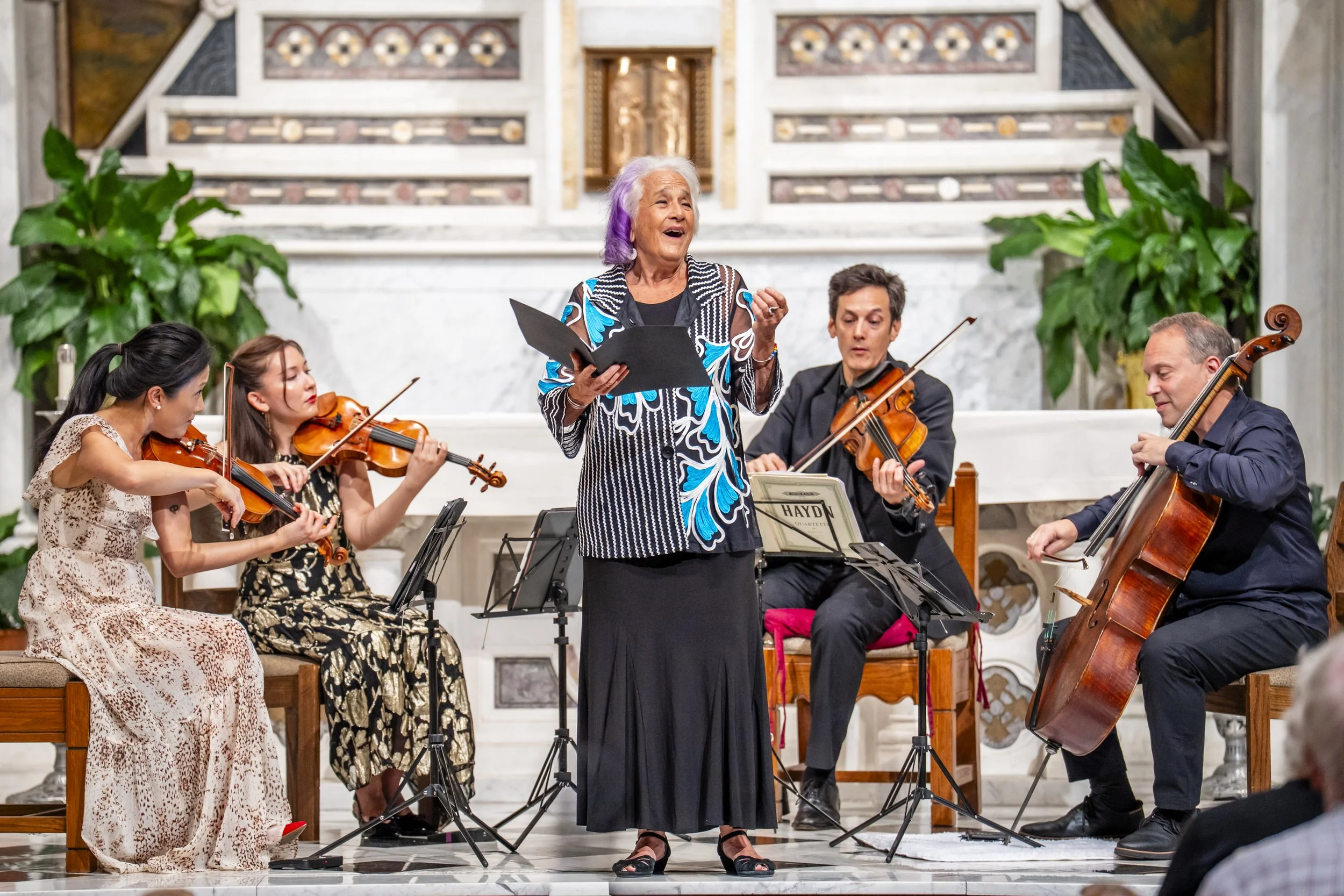
Soprano Lucy Shelton performs with the festival quartet during the Newburyport Chamber Music Festival. From left: Lisa Lee and Isabelle Xi Durrenberger, violins; Shelton; violist and NCMF artistic director David Yang; cellist Christopher Costanzo. Matthew Muise photograph
Even summer festivals have a tell. The Newburyport Chamber Music Festival has two.
The first tell: having soprano Lucy Shelton as headliner. That told on the festival’s repertoire; bringing in a sublime interpreter of contemporary art-song to explore her expertise in multiple 20th and 21st century settings.
The second tell was more subtle. Each time artistic director David Yang tried getting his post-intermission audience back to their seats, he would say loudly, “We’re all here, right?”
The “we.” That’s the second tell. NCMF is a “we” experience.
While blending sharply edged repertoire with a casually involved atmosphere, NCMF, tucked away in coastal Newburyport, itself tucked into the northernmost Massachusetts corner along the Atlantic, has remained largely unchanged in its 25 years.
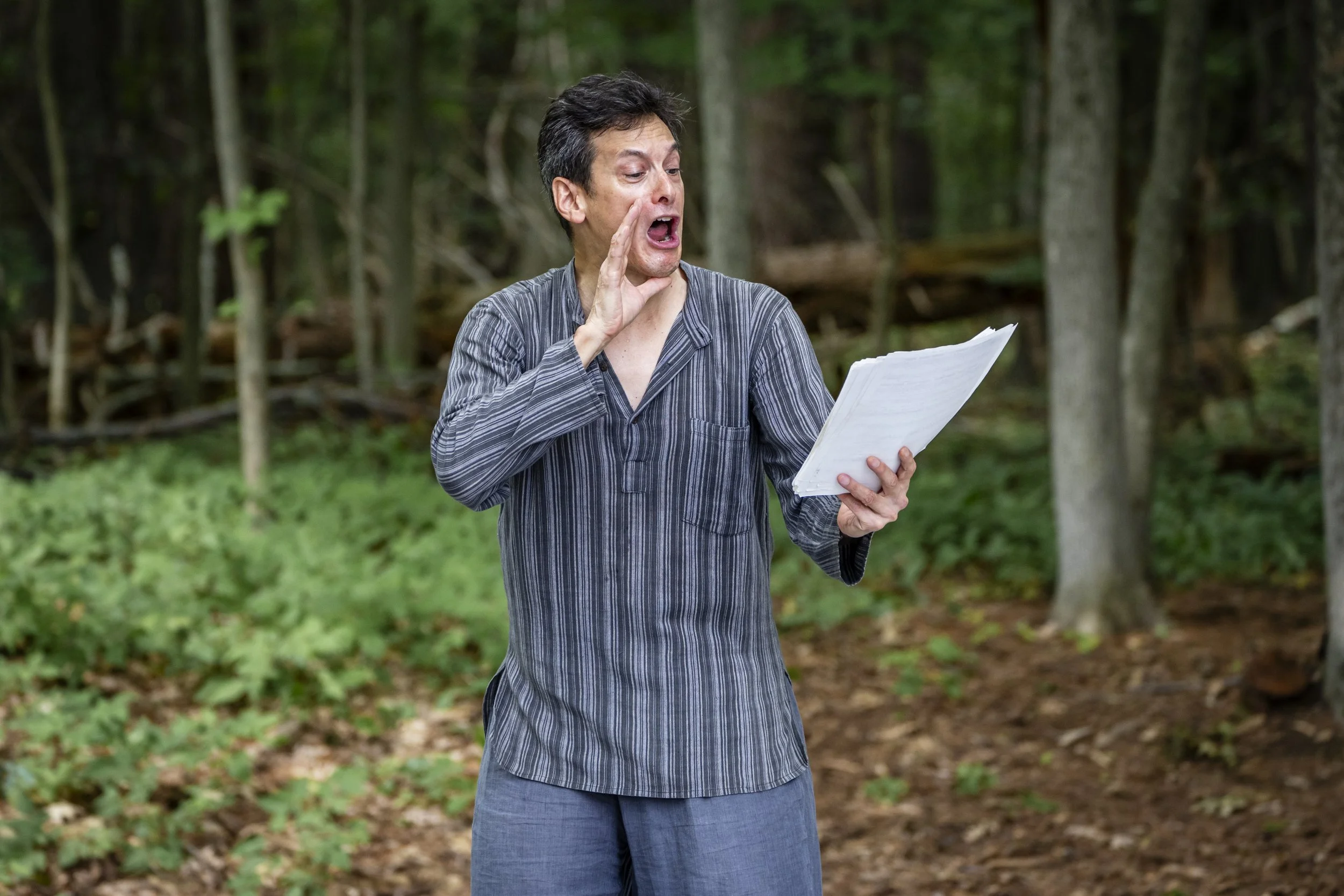
David Yang in character: the Newburyport festival brings musicians, poets and actors for puppet theater, house performances, public rehearsals and lots of music. Matthew Muise photograph
NCMF starts with David Yang, violist, chamber musician, theater guy. Yang comes to Newburyport with instrumentalists, composers, poets, singers and actors each August for concerts, puppet theater, public rehearsals, house performances, and discussions.
Yang—who teaches chamber music at Penn, heads the theater troupe Auricolae there, and runs a similar festival to NCMF, the Ashburton Chamber Music Festival, in the south of England—has a hand in everything here: puppet theater, preconcert talks, and of course as violist in the perpetually active festival string quartet. He also writes prolifically: all the program notes, and an impressive blog that keeps his audience connected during the year. He raises funds the sweaty way: this year, he biked from Philadelphia to Newburyport, encouraging funders with just plain hard work and healthy fun.
The festival has no executive director; the omnipresent board members—a “help with the folding-chairs” board, not a “I just grew my hedge fund again” board—act more like caretakers of something special, rather than a bunch of fancy people doing fancy things. Most attendees are repeaters, devoted to whatever presentation Yang offers.
The work ethic of the performers impresses. It’s a small cast, and they have services day and night. Violinists Lisa Lee and Isabelle Xi Durrenberger joined Yang and the excellent cellist Christopher Costanzo for the unrelenting schedule. These aren’t just dedicated professionals, but also artists who would rather extend themselves into the esoteric corners of their own interests, rather than coast through easier repertoire somewhere else.
Having Lucy Shelton here epitomized the intimacy and exceptionalism of NCMF. Shelton’s recent international appearances as the Teacher in the late Kaija Saariaho’s final opera Innocence, have simply added more luster to decades of interpreting the most challenging 20th and 21st century vocal literature. No listing of achievements does her career justice; simply search “Pierrot Lunaire,” and Shelton’s name appears quickly. Not many singers make a Met debut at 82, which Shelton did this past April. The nine decades of resonance and life in Shelton’s voice were essential to all her performances at NCMF.
Shelton reached for a vibrato-charged falsetto in Cathy Berberian’s exuberant Stripsody. Berberian, Shelton’s own precursor in the ’50s and ’60s as a boundary-less contemporary performer, compiled her own score for Stripsody from comic strips. There are no notes, just caricatures, wavy lines with syllable sounds, and lyrics like KABOOM. Non sequiturs piled one upon another in a chain of goofiness; the graphic score made phenomenal vocal demands. It requires unique virtuosity; every one of the evening’s other musicians came out into the hall to witness Shelton’s performance.
Shelton also sang two poems from poet-in-residence Rhina P. Espaillat, in settings for voice and quartet by Jon Deak, a frequent guest here as musician and composer. Deak gave musical life to the underlying premise of “The Jury,” which premiered in 2023 at NCMF. Four birds (underscored robustly by instruments) speak in bemusement about the plight of humans, suggesting gently that the birds simply wait out the humans until they’re gone. The poem itself speaks gently, almost condescendingly, about human foibles.
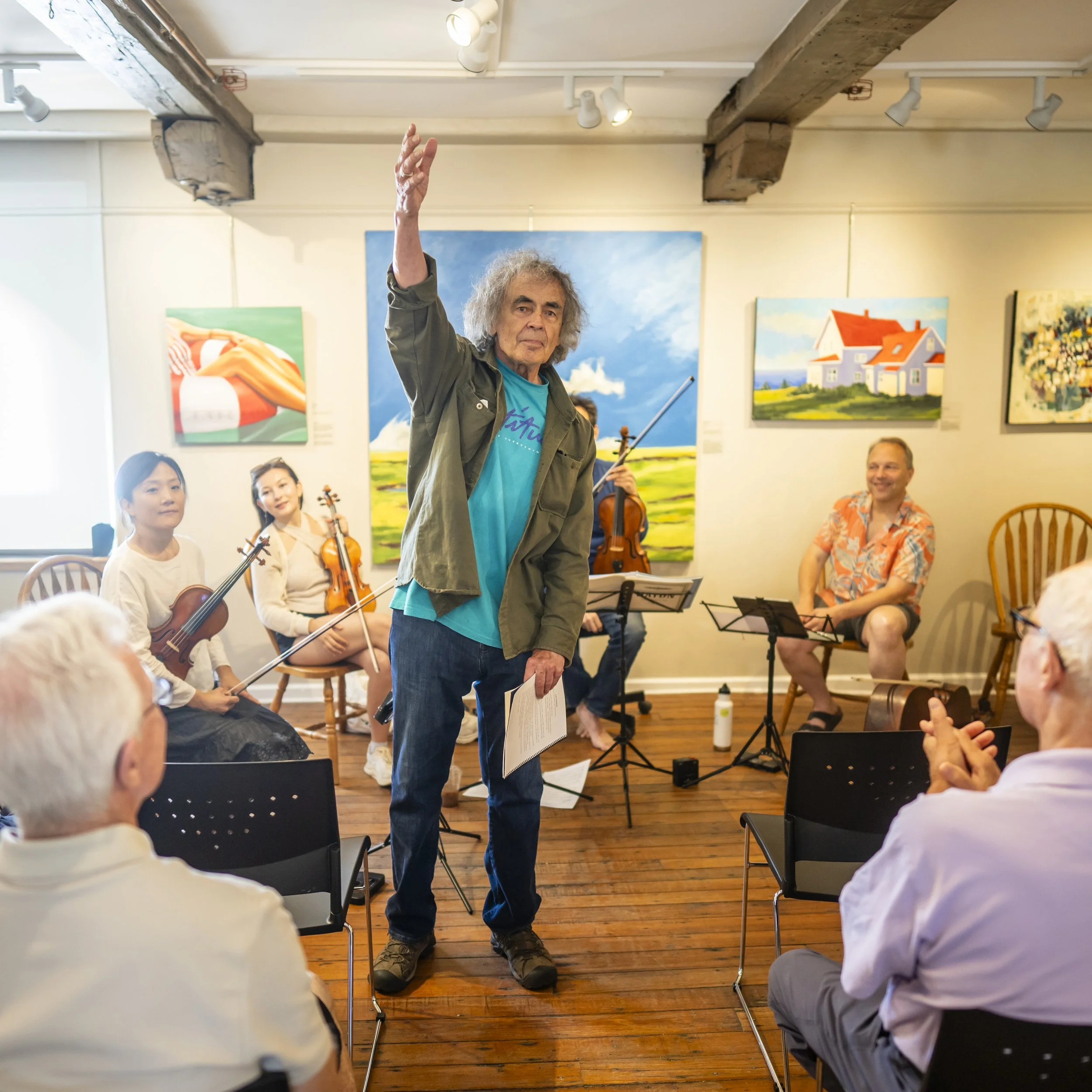
Composer Jon Deak at an open rehearsal, with the festival quartet. Deak’s collaborations with poet-in-residence Rhina P. Espaillat were a festival highlight. Matthew Muise photograph
But Deak’s music leaves no doubt—rushing, almost angry, forceful. The music’s relationship to the words felt distant, but the message doubled in effect. When Shelton enters as the last bird—Eagle, off-handedly dismissing the “small smudge” humans have left in a swirl of noise, it showed another side: Shelton as a gentle interpreter, above the fray.
That wasn’t all for Shelton: From the corner of a church hall, Shelton intoned Morton Feldman’s solo from Only; she also sang four Copland songs, one of the Espaillat poems and Berberian’s comic text in the same concert. She capped the meditative Nachtmusik concert with an ethereal conjuring of an unnamed poem, and performed at multiple Hausmusik and rehearsal presentations as well.
An air of theatricality permeates many performances. The annual Nachtmusik program packs a small chapel full of listeners, turns off the lights, and forbids applause or talking before or after. No program, no notes, no discussion, just music. The festival quartet played a dozen small works and movements, and Shelton, hidden away from the other performers in a corner, closed with an a cappella poem. The result was mesmerizing: an hour of music in darkness alters the mind.
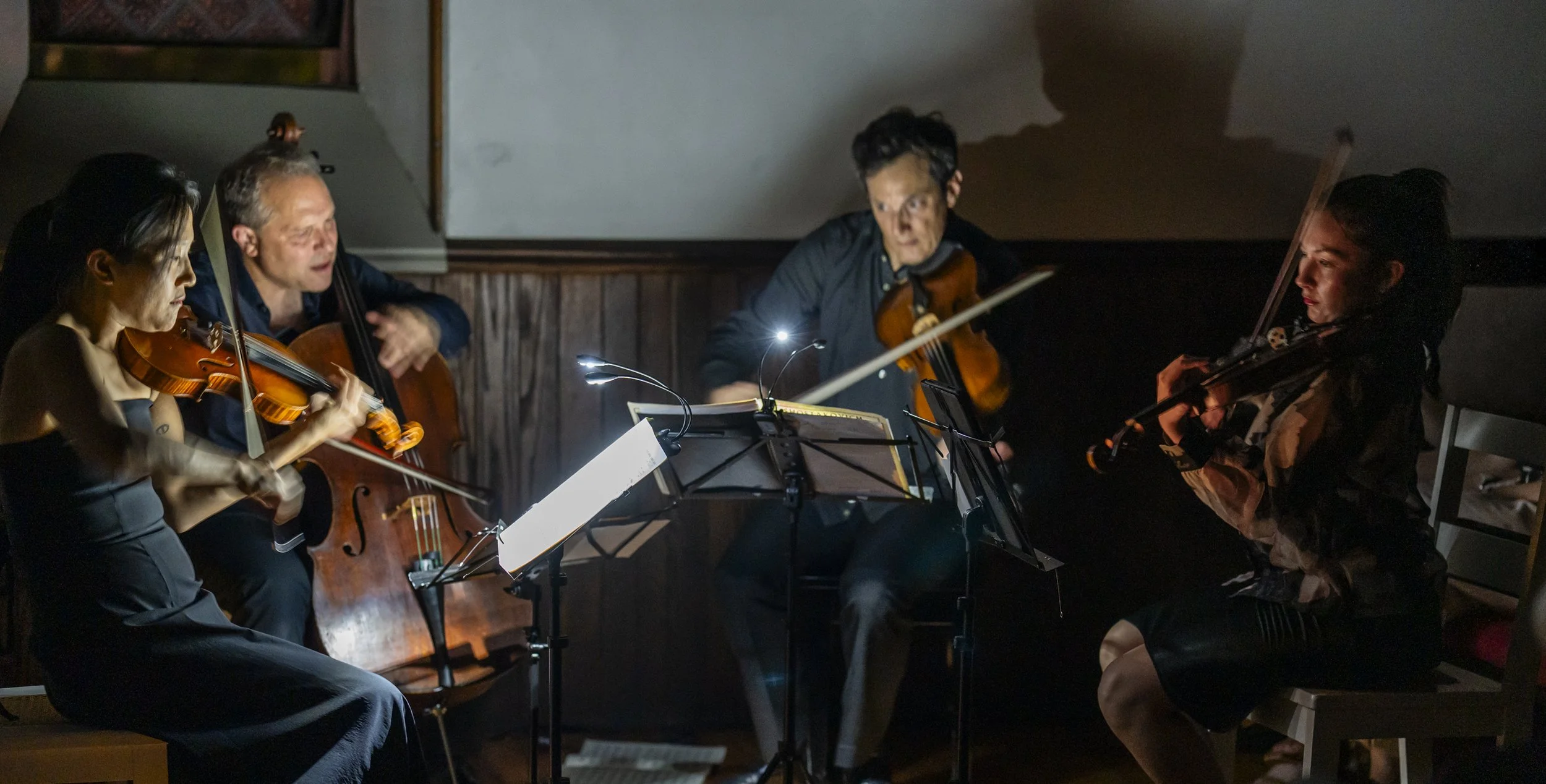
Nachtmusik: Entire concert in the dark, no notes, no applause, no comments—a mood-altering experience. Matthew Muise photograph.
Other moments at the festival proved memorable: Pianist Kenneth Broberg arrived directly from Spain, where wildfires had driven him from his home. He apologized for being unable to prepare his major work—Liszt’s Mephisto Waltz—and gave a warm recital of Haydn and Mozart, with preludes and fugues from Shostakovich and Mendelssohn.
Lang, definitely a theater kid inside, performed theatrical narrations with music for dozens of theater camp kids; and the season-closing octet performances (Mendelssohn and Shostakovich, the Moctet and Shocktet, as Yang called them), with the festival foursome, joined by the Miró String Quartet, made joyful festival closer.
The Newburyport Chamber Music Festival ran from Aug. 5 through 15.