
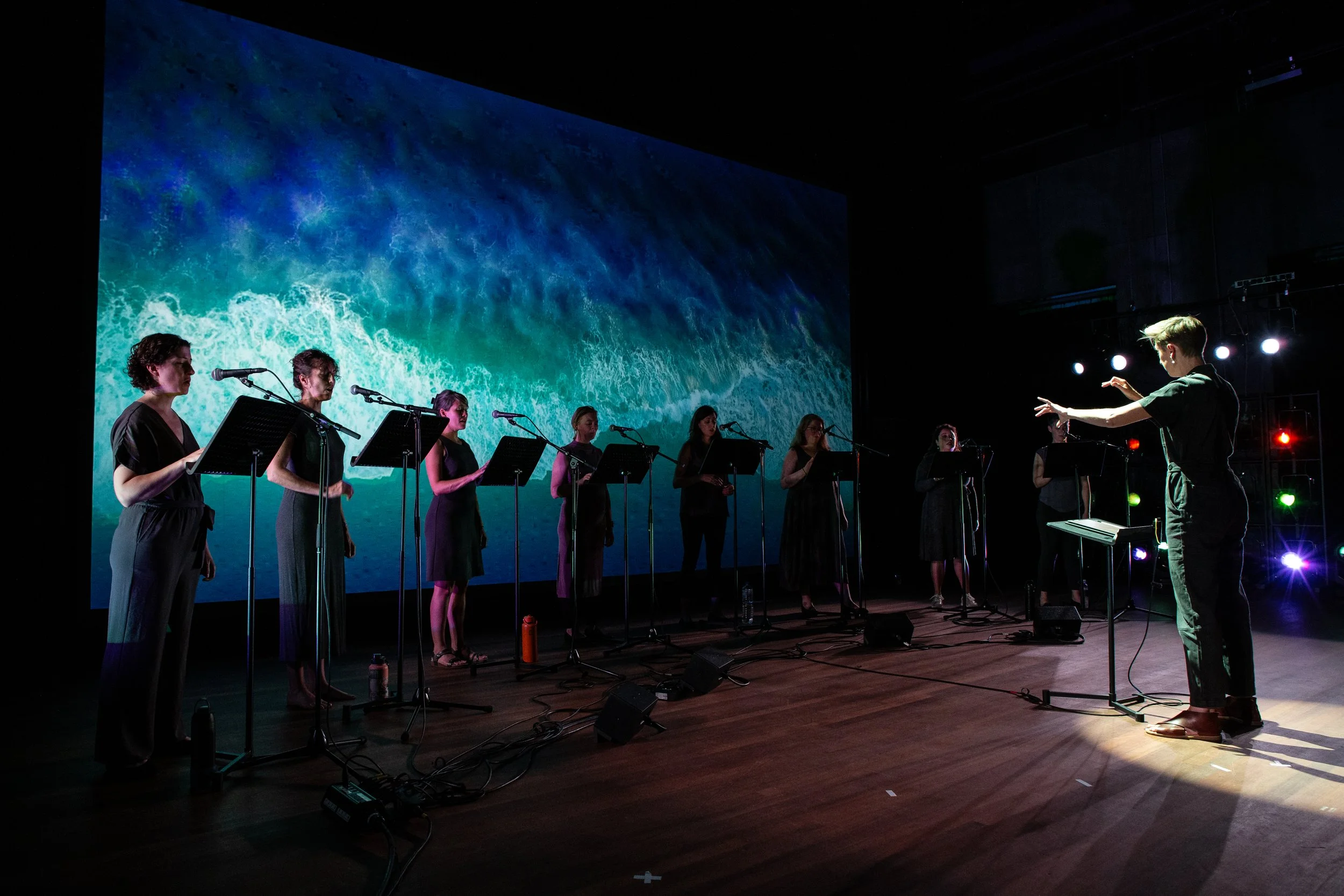
Lorelei Ensemble, with founder Beth Willer directing, in a performance of Christopher Cerrone’s Beaufort Scales. Melle Meivogel photograph
From Classical Voice North America. Read it there—they paid for it—or face penalties. Thanks.
It’s an issue for every librettist who addresses concerns like climate change: how to be thoughtful, and thought provoking, without shaming or hectoring. It can be a fool’s game.
Or a fine line, at least, which separates empathy from accusation. The eight voices of Lorelei Ensemble, in a program called LOOK UP that has Christopher Cerrone’s oratorio Beaufort Scales as its centerpiece, walked that fine line March 20 in a performance at Boston’s Institute for Contemporary Art.
Cerrone’s libretto, created for adventurous voices and permeated with electronics, mixes the dozen levels of the nautical Beaufort Scale with literary excerpts about wind and weather.
The Beaufort Scale was created two centuries ago to measure ocean winds, using vernacular language, simple and gently poetic. Ranging from the mildest (“Sea like a mirror. Smoke rises vertically”) through growing stages of turbulence, all the way to the climactic finality of “Destruction,” the Beaufort Scale opaquely describes the winds. That directness, and lack of didacticism, makes the libretto far more persuasive.
Lorelei Ensemble, led by founder/artistic director Beth Willer, occupies a place of honor among the many innovative vocal groups, after almost two decades of performing, and more than 70 new works premiered. Beaufort Scales was one of those Lorelei commissions, and Cerrone is a frequent collaborator. A 2025 recording gained a Grammy nomination, one of five Lorelei has received. The ensemble appears regularly in the ICA’s black box Barbara Lee Theater.
Willer’s concept program comes through-composed, or through-conceived, linking shorter works in the same spirit by Meredith Monk, Molly Herron and Elijah Daniel Smith, performed without break with Beaufort Scales.
Cerrone’s oratorio relies solidly on electronics as a separate instrument, at first as a hiss track, then with barely audible dialogue, and continuing to grow in interaction between singers and text. The Beaufort readings are set in a crescendo of distortion and noise, interpolated with narrations—from Herman Melville, Anne Carson, F. Scott Fitzgerald—that interrupt the expanding storm of sound.
Following a selection from Carson’s Anthropology of Water, a final melodic respite, the text and images begin shrieking with interference. A final excerpt, from Moby-Dick—the St. Elmo’s Fire chapter, when the sailors marvel at electronic outbursts in a storm—feels apocalyptic. From each of these excerpts the libretto returns to the words of the Beaufort Scale, bloodlessly marking the march toward natural destruction.

Composer Christopher Cerrone. His oratorio Beaufort Scales, for vocal octet and electronics, uses the straightforward language of the nautical scale for wind measure to probe the intensity of the changing climate. Courtesy photograph
Lorelei played various roles: doubling a taped narration, doing the narration, dissecting the nuances of the text. Willer’s role as conductor seemed equally demanding: guided unforgivingly by a click track, she balanced real-time video (footage of the ocean, itself eventually distorted), her octet of singers, and electronic processing. This metronomic balance underscored the oratorio’s concerns: as the work progresses, voices become less human, increasingly unhinged, and further alienated.
The sonic presence of Meredith Monk, in two wordless ensemble settings from her 1990s opera Atlas, felt particularly effective—a case where meaningless sound establishes an inherent understanding. The singers recreated two scenes from Act 3 of Atlas: the arm-on-shoulder line mannerisms from “Other Worlds Revealed,” and the processional “Earth Seen from Above,” the singers eventually looking away from each other, standing but twisting in ungainly contortions.
The ensemble stood stoutly at the mike for Herron’s Stellar Atmospheres. Its libretto, formed from voiced 1s and 2s, made a pixelated narrative, inscrutable but commanding. Herron’s setting slid easily into Elijah Daniel Smith’s Suspended in Spin, with his text—from Tracy K. Smith’s Pulitzer–winning poetry collection Life on Mars—projected on the screens.
The singers were not easily identified from the program book, but everyone moved organically and sang crisply in a synchronized performance from lights down to lights up. The lower voices especially sang with authority (the octet was cast SSSSMMAA). Sound engineering, a particular challenge of synchronicity in Beaufort Scales, was smartly managed by Kevin Corzett.