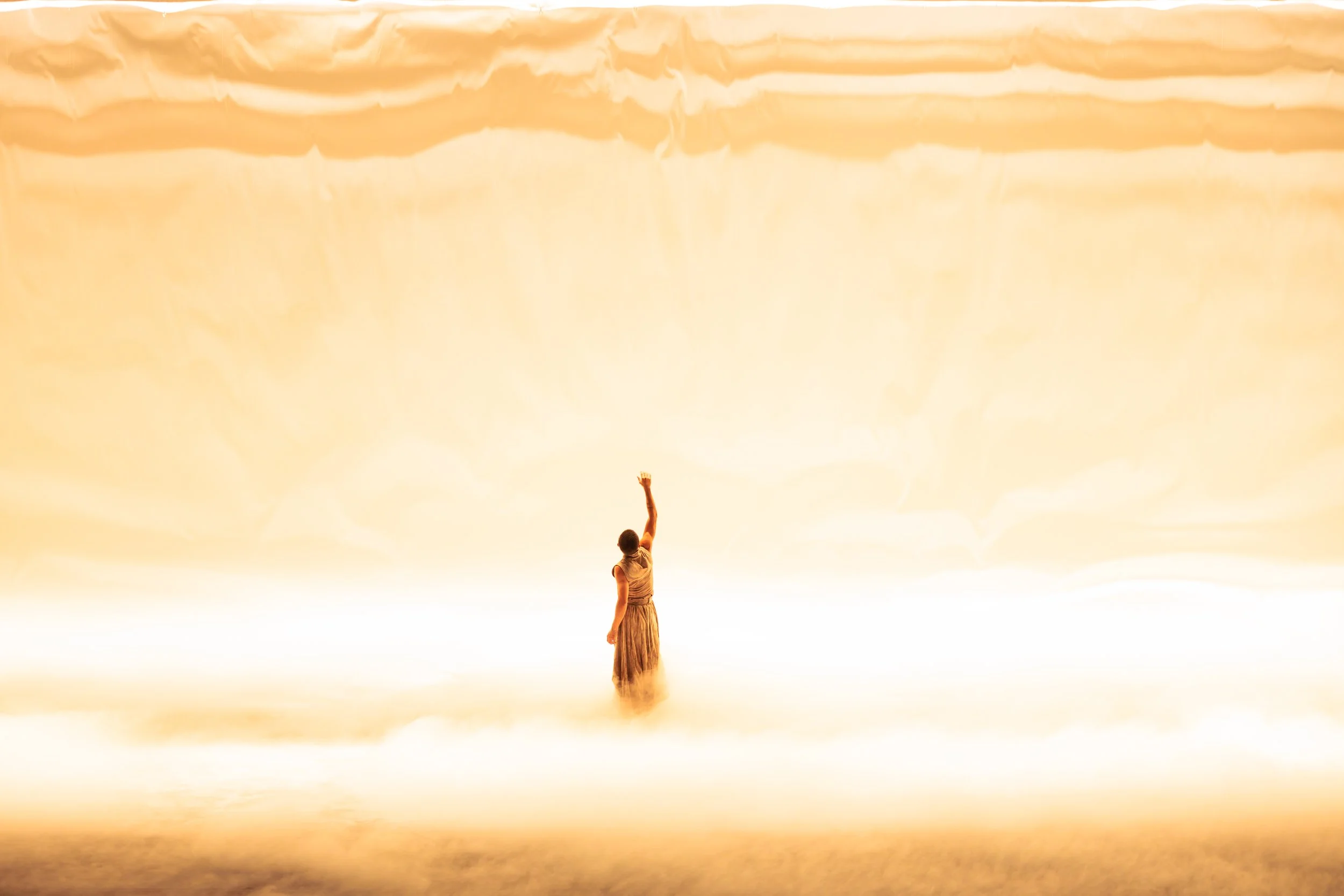
Jeffrey Cirio in Akram Khan’s Vertical Road (Reimagined). Theik Smith photograph
Boston Ballet began its season with two recent works, Cacti by Alexander Ekman (premiered by Nederlands Dans Theater 2 in 2010) and Vertical Road (Reimagined) by Akram Khan, premiered by BBallet in 2023. My highlight was the orchestra-only introduction, selections from the 1919 Firebird Suite. Cheers to everyone in the pit. I was not the only one noticing that Stravinsky held the interest of the just-here-for-the-dancers crowd far more effectively than the electronic thunk-a-chunk score that followed.
I had not prepared, so only minor judgment here. The dancing was mostly gymnastic, but smoothly prepped and nicely accomplished. Khan’s piece features an untrustworthy narrator—something I disdain. That disdain comes from having to re-read somebody’s (not saying) 600-page novel when I found out the narrator was a liar, somewhere around page 500.
One creator I did trust was Annie Dillard, who passed away recently. Pilgrim at Tinker Creek showed writers that you could simply walk out the front door and find more subject matter than you need. I’ve looked at the front yard, or any other random and mundane view, differently since the 1970s. I’ve never felt like I played an predominant part in the world of music-making, through journalism. But I know I’m part of the environment, or the ecosystem, and like any ecosystem every part belongs somehow.
Dillard was a fitful insomniac, and once wrote “if I can bear the nights, the days are a pleasure.” That reads like bravery to me, or fundamental optimism. A la prochaine.
I spent most of September soaking up Eric Nathan’s violin concerto, the review of which is posted here at LO and was an assignment from CVNA. I enjoy variety, but also enjoy spending several weeks with one score, reviewing past recordings (and past reviews), making it to a rehearsal, and luxuriating in the time to assess and to write.
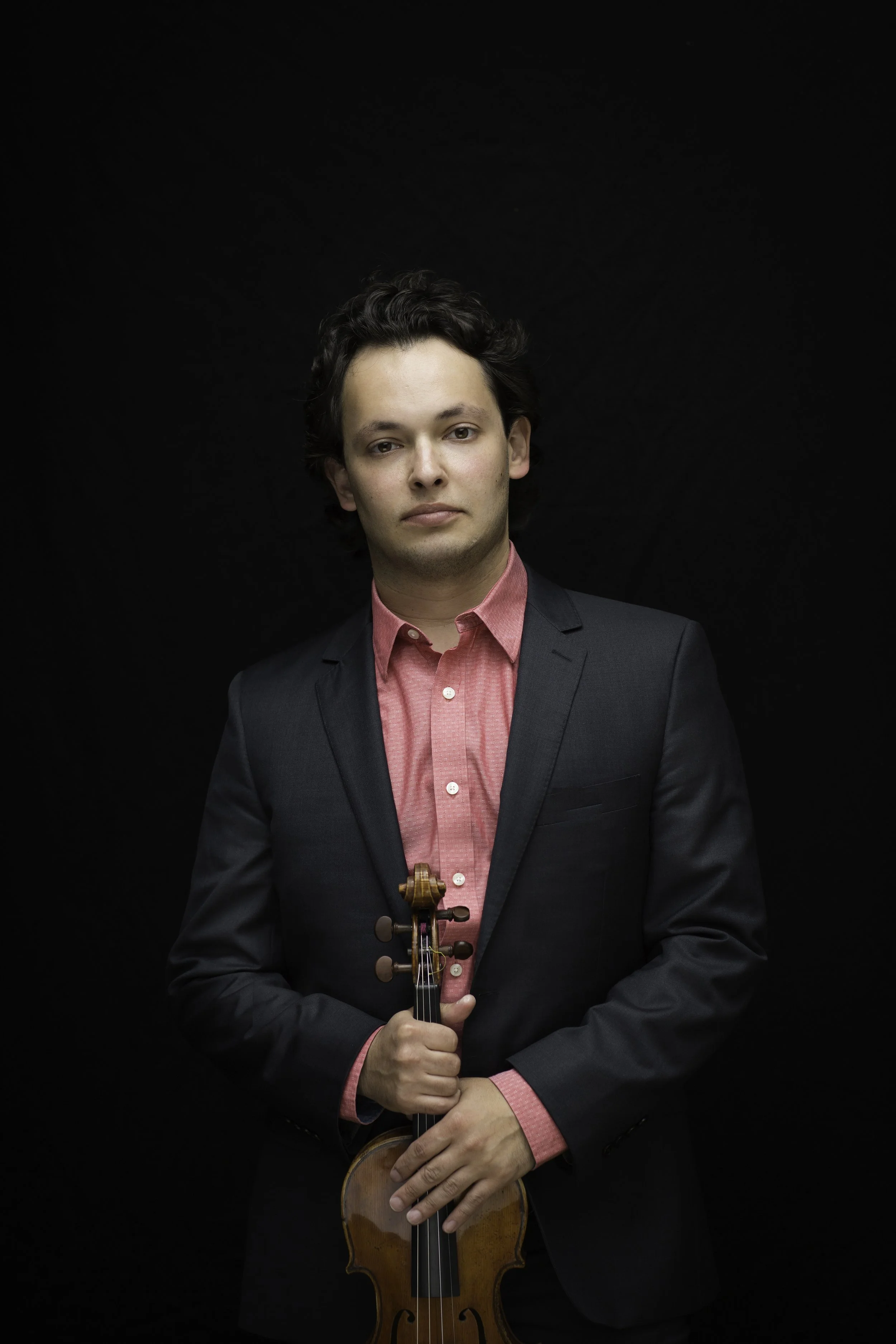
Yevgeny Kutik, who premiered Eric Nathan’s violin concerto The Mountains We Climb with the Rhode Island Philharmonic in September. Corey Hayes photograph
It’s a robust concerto, with an equally robust consortium of eight orchestras that commissioned it. The Boise Philharmonic, Two Rivers Chamber Orchestra, St. Paul Chamber Orchestra and the Bay Atlantic Symphony are just some of the distinctly regional ensembles—a particular love of mine—who will learn the piece. Three different violinists were part of the commissioning group as well: Yevgeny Kutik, who gave the premiere with the Rhode Island Philharmonic; and also Stefan Jackiw and Curtis Stewart, who are scheduled for the other regional premieres. I did just learn that Stewart is stepping away from performances for the next year.
I must note another memorable premiere, at the Boston Symphony in September: Sofia Gubaidulina’s Prolog. Elena Firsova completed the score, left unfinished when Gubaidulina passed in March 2025. The premiere adds to Gubaidulina’s long association with the BSO—there have been numerous premieres and performances over the past three decades.

Gubaidulina’s voice comes hardwired inside me, like firmware, probably because of repeated exposure to her work, both in Boston and in New York where I first met her. I was wandering that sonic universe from the opening measures of Prolog.
This was a complicated premiere, related to other works and ideas. Firsova’s completion made it even more complicated. Please look up my colleagues, Aaron Keebaugh (at ArtsFuse) and Jonathan Blumhofer (Boston Classical Review), who were covering the premiere, as was Jeffrey Gantz at the Intelligencer.
A personal anecdote about Gubaidulina: I interviewed her several times, but one time, in person, in Boston, stands out. I brought a translator (a Russian); Gubaidulina had a translator as well (an American). The topic was synaesthesia, or was meant to be.
Unbeknownst to me, the translators knew each other, and disliked each other. Additionally, there was a fierceness about Gubaidulina that my translator summarized as “she’s Tatar, after all.” Those things resulted in a truly hilarious transcript: me asking dutifully polite color/sound questions, and then the three of them going off in many fraught directions. Au revoir, et merçi pour tous.
The Cape Ann Museum reopened this summer after two years. The Avery, Gottlieb, and Rothko show was on view, and drew plenty of attention. The museum’s renovations seemed mostly cosmetic, so a fancy show to reopen the doors proved wise. It was a Milton Avery show really; more than half the works were his. It did seem appropriate, since this is a Cape Ann creation, and Avery is more Cape-Annish than the other two. And the meeting of the three artists on Cape Ann was kinda trivial to their work, in sum. As you would expect, most of the media attention focused on Rothko. Tant mieux. The exhibition travels to the Phillips Collection in D.C.