
From CVNA: Lincoln leaves Washington. Philip Glass's 15th Symphony premieres at Tanglewood.
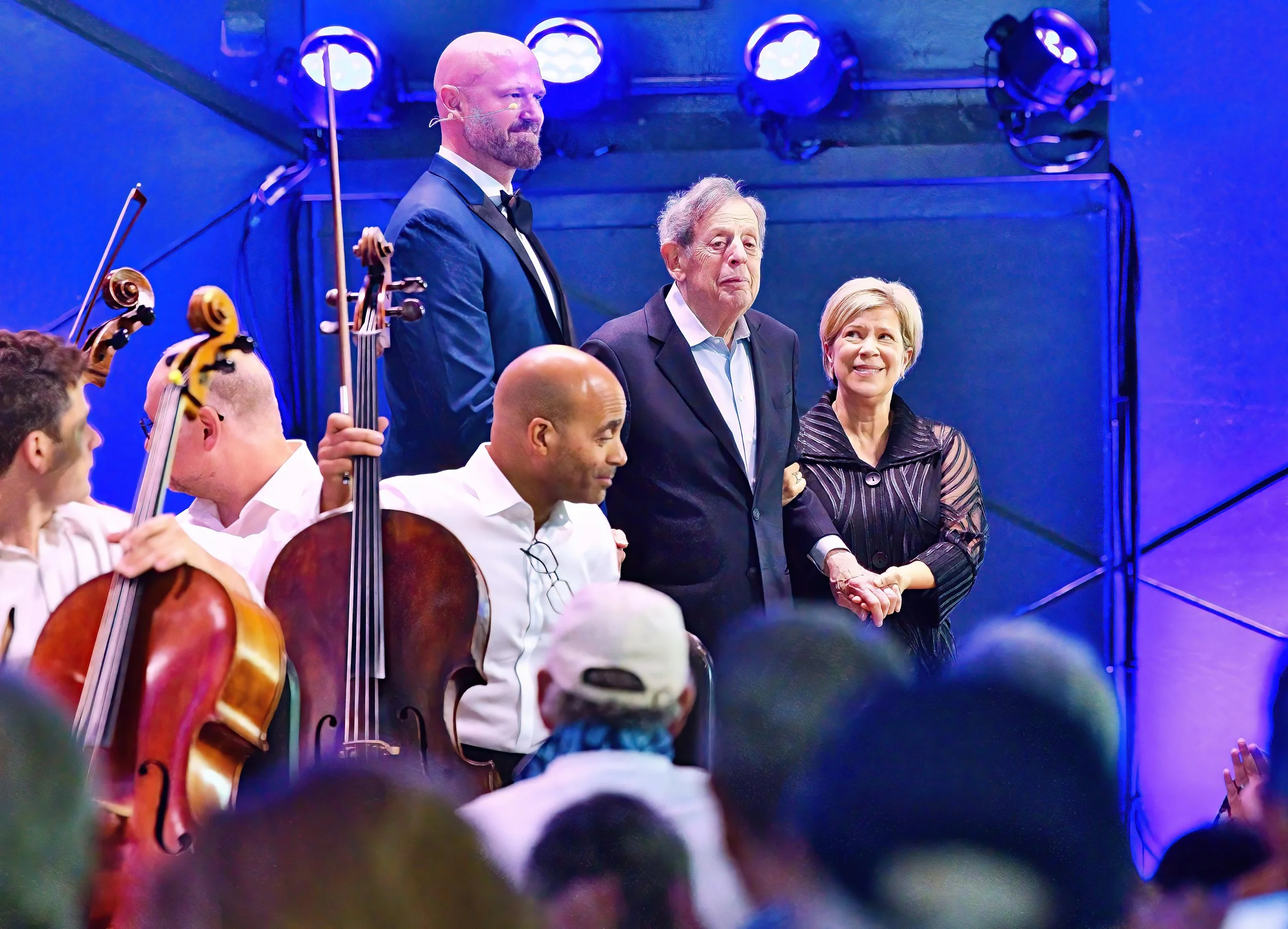
Philip Glass acknowledges the audience onstage in the Shed at Tanglewood, July 5, with baritone Zachary James and conductor Karen Kamensek. Hilary Scott photograph
Who better as America’s emblematic composer than Philip Glass?
In anticipation of the nation’s quarter-millennial festivities, Glass was commissioned for a symphony honoring the indisputably emblematic Abraham Lincoln, and the premiere was scheduled for Washington’s Kennedy Center as part of this year’s independence celebrations.
Aversion to the current administration changed those plans, but while the composer declined the premiere at the Kennedy Center, he finished the commission, his 15th Symphony.
The work was premiered at Tanglewood July 5 by the Boston Symphony Orchestra, with conductor Karen Kamensek. The all-Lincoln program also included John Williams’s orchestral suite from the film Lincoln, and Aaron Copland’s stirring orchestral narration, Lincoln Portrait, with actor Alec Baldwin reading.
Glass set Lincoln’s own words for baritone and orchestra, with longtime Glass interpreters Kamensek and Zachary James (the singing and narrative voice of Lincoln) joining the BSO.
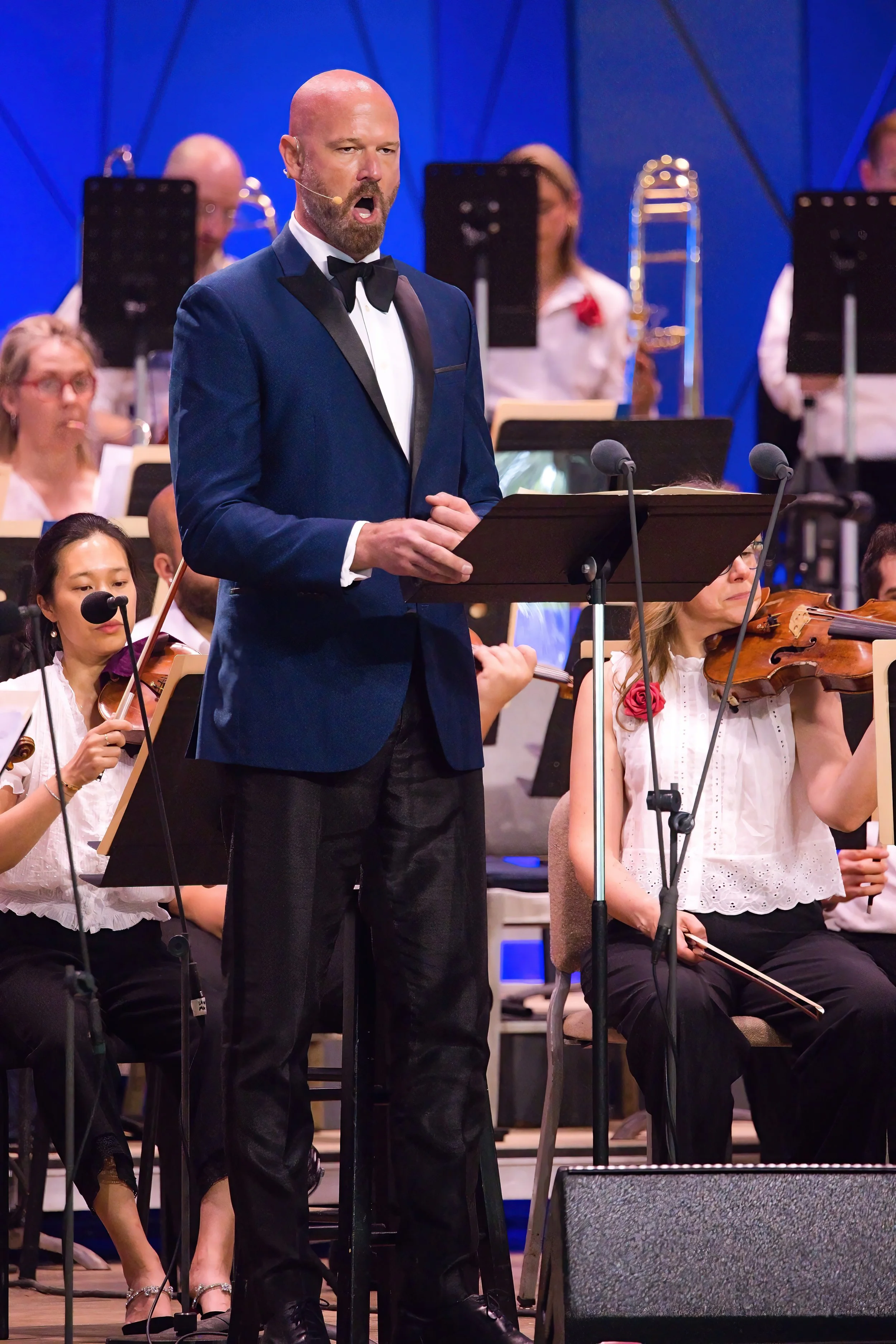
Baritone Zachary James, a frequent Glass collaborator, realizes Lincoln’s character in Glass’s 15th Symphony, at Tanglewood July 5. Hilary Scott photograph
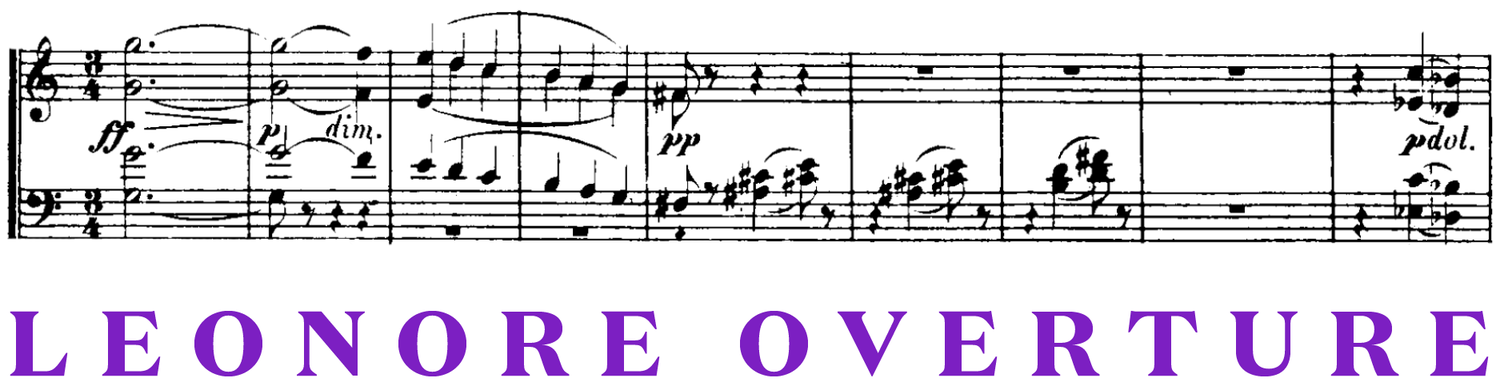
The 15th Symphony enters the substantial Glass catalog: some two dozen operas, among the most renown of this generation; dozens of chamber works, including vast piano literature; film scores (Koyaanisqatsi, Dracula, The Thin Blue Line, Kundun) with depth and poignancy. Glass—once the downtown rebel—has become an eminent musical voice in his generation. The composer was in attendance, and received a tremendously respectful ovation afterward.
This event yearns for heated political discussion; let’s focus on the music. Lincoln weaves eight movements, with little break, setting the 16th president’s own words, but in Glass’s own chronology. Overall, the mood is declamatory, not dramatic: Lincoln’s words, taken from various texts, speak about how he feels, and wonder how he might be judged by history, but are not at all forceful. Some of the movements close inconspicuously, off-handedly, as if the speaker still had some thoughts unsounded. Lincoln did not lead by bluster.
Glass establishes a familiar minimal mood in the orchestra: a repeated triplet motive, ascending and descending, largely in the strings, shifting slightly over time. Accents of all kinds and strikingly melodic interludes recurred throughout, but the original repeated structure never disappeared.
This symphony isn’t long-form Glass, elaborately experimenting with extensive repetition and gradual metamorphosis; it lasts about a half-hour. The recurring instrumental pattern served splendidly as a backdrop for James’s vocal line, which stayed closer to sprechstimme—some direct narration, some gentle simple melodies. Only a final pronouncement, a basso profundo “I bid you an affectionate farewell,” followed by an equally deep conclusion in low brass, added drama to the presentation.
Instrumental accents—harp, horns, bassoon, wood-block patterns eluding the downbeat—supplied quirkiness. A chorale-sounding interlude during the second movement—left partially achieved—sounded anomalous, like a reference to a different era. This Lincoln, taciturn and melancholy by reputation, shows some humor: of his early military service, he remembers “many bloody struggles with the musquitoes.”

James, Glass and Kamensek hug after the performance. The all-Lincoln program also included John Williams’s orchestral suite from the film Lincoln, and Aaron Copland’s stirring orchestral narration, Lincoln Portrait, with actor Alec Baldwin reading. Hilary Scott photograph
Glass’s Abraham Lincoln is hardly a populist rouser; the president in Aaron Copland’s Lincoln Portrait is just that. Copland wrote Lincoln Portrait in 1942, based on Carl Sandburg’s character-defining biography of Lincoln, which won a Pulitzer Prize in 1940 when its sixth volume was published. Musically, it’s proper Copland, mining his own affection for folksongs, exploring the idiom that has become an American staple. Alec Baldwin joins a list of distinguished narrators, including Sandburg himself, and former presidents and contenders like Barack Obama and Hillary Clinton.
John Williams contributed the score to Steven Spielberg’s film Lincoln in 2012, and created a concert suite from the soundtrack soon after. The suite has stayed in the regular Boston Pops rotation since then. Much as Copland’s Lincoln Portrait is pure Copland, Williams’s Lincoln sounds like pure Copland as well. The quotes and references are intentional, with unmistakable: snippets from Appalachian Spring, Billy the Kid, and Lincoln Portrait itself.
Characterful smaller moments—flute and cello solos (Elizabeth Klein and principal Blaise Déjardin), some country fiddling from concertmaster Alexander Velinzon, bold statements by principal trumpet Thomas Rolfs—colored in Williams’s musical portrait.
The three works create a substantial remembrance of a substantial president. Glass’s symphony does not repeat at Tanglewood, but his Lincoln has multiple performances scheduled throughout this year and next. The New York premiere, with the Orchestra of St. Luke’s at Carnegie Hall, will mark the composer’s 90th birthday in January 2027.